43 Modern Front Door Ideas to Upgrade Your Home Entrance This Year
Disclosure : This post may contain affiliate links or paid partnerships. I may earn compensation if you click a link or make a purchase, at no additional cost to you. See my disclosure for more info.
Your front door is doing more work than you realize.
Before anyone sees your interior, before they notice your landscaping, before they experience your home at all — they’ve already formed an opinion based on what’s right in front of them.
That opinion starts with your door.
If it’s faded, dated, or just forgettable, that’s the first impression your home is making. Every day. On everyone who visits, delivers, or simply drives past.
The good news is that this is one of the most fixable problems in residential design. You don’t need a contractor. You don’t need a budget overhaul. You need the right idea.
Here are 43 of them.
High-Impact Door Colors That Work in the Real World
Paint is the single highest-ROI investment you can make on a front door. The right color can transform a forgettable facade into a standout one for under a hundred dollars.
These six colors have proven track records across a wide range of exterior styles.
1. Flat black with aged brass hardware. This pairing has become a modern classic for good reason. It works on virtually every house style and exterior material, and it doesn’t date.
2. Burnt terracotta. Warm, grounded, and unexpectedly contemporary. Works best against pale or neutral siding where the warmth of the color can contrast cleanly.
3. Deep hunter green. A color that reads as serious and intentional. Pairs especially well with brick, stone, or natural wood cladding.
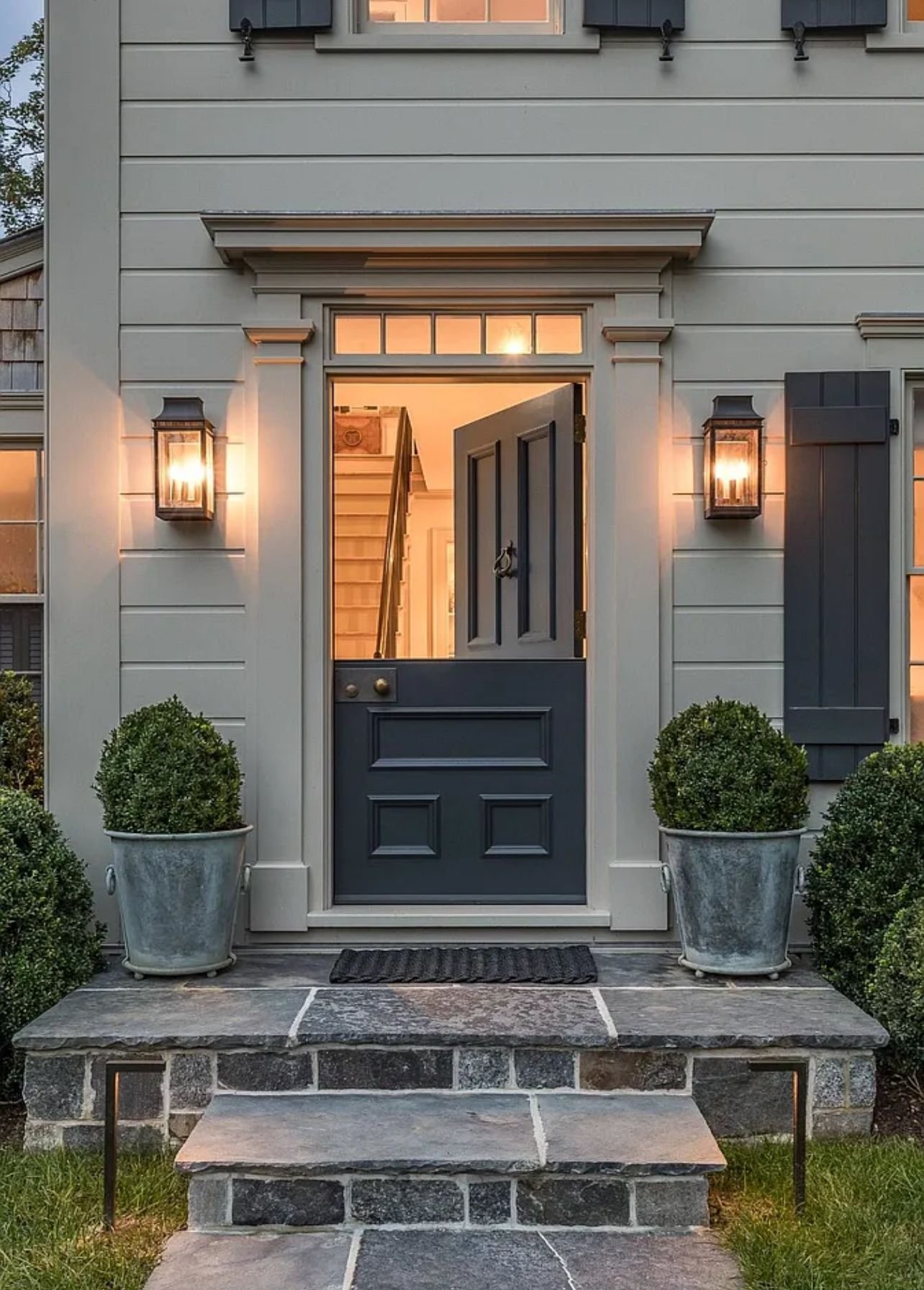
4. Ink navy. Deep, rich, and composed. Satin finish holds up to weather and maintains its depth over time better than flat sheens.
5. Muted sage. Neither aggressively bold nor boringly neutral. Sage occupies a useful middle ground that suits a wide range of exterior palettes.
6. Warm charcoal. When black feels too stark, charcoal provides the same visual weight with a softer edge. Particularly effective on pale facades.
Practical note: paint your door on a dry day above 50°F for best adhesion. Two thin coats will outlast one thick coat. And always test in natural light — showroom swatches lie.
Pivot Doors — Architecture You Open Every Day
Standard doors hinge from the side. Pivot doors rotate from a central point and create a completely different experience of opening and entering a home.
They’re a serious upgrade — in cost and impact.
7. Full-height timber pivot. Height and movement together. These doors make every entry feel like an event. Particularly effective in homes with double-height ceilings or tall facades.
8. Steel and glass pivot. The narrow steel profile and floor-to-ceiling glass let natural light flood in while the pivot mechanism creates a theatrical opening experience.
9. Anodized aluminum pivot with privacy glass. A more understated approach to pivot design. The frosted or reeded glass panel maintains privacy while still benefiting from the pivot’s movement.
Budget realistically for pivot doors. Custom fabrication, structural reinforcement, and professional installation are all typically required. But if your entry needs a fundamental rethink rather than a surface fix, this is the kind of change that delivers results proportional to the investment.
Using Glass to Fix a Dark, Unwelcoming Hallway
A dark foyer is one of the most common complaints in residential design. The solution isn’t always more lamps — sometimes it’s changing the door.
10. Full-panel glazed door. For entries that aren’t directly overlooked from the street, full-glazing brings in daylight that transforms the immediate interior.
11. Obscure or frosted half-panel door. Light passes through. Detail doesn’t. A practical compromise for entries with limited privacy.
12. Flanking sidelights. Adding one or two slim glass panels beside an existing door is often the simplest intervention with the most immediate visual impact.
13. Overhead transom. A horizontal glazed panel above the door frame. Brings in high-angle natural light that is warm, even, and architecturally credible.
14. Textured reeded glass. Currently one of the most popular glass treatments in contemporary residential design. Light diffuses attractively while maintaining privacy.
Before specifying any glazing, consider your entry orientation and neighbors. A north-facing door gains less direct sunlight; a door facing directly onto a footpath needs obscure glass. Match the solution to your actual situation.
Wood Doors for Contemporary Homes
Wood doors have a poor reputation in some circles, mostly because of dated examples. Contemporary wood doors are a different category entirely.
15. Quarter-sawn white oak, vertical orientation. Clean, refined, and warm without veering toward rustic. The consistent grain pattern of quarter-sawn timber gives a more formal, architectural quality.
16. American black walnut slab. Dense grain, dark tones, and a natural luster that develops over time. One of the most visually sophisticated door materials available.
17. Teak with linear horizontal detailing. The horizontal banding creates rhythm and a contemporary feel. Teak’s inherent oil content makes it one of the most weather-resistant timber choices.
18. Scandinavian-style pale maple. Straight-grained, light in tone, and minimal in character. The closest wood equivalent to the restraint of Scandinavian design.
19. Reclaimed hardwood with a clean profile. The character of aged timber within a contemporary door profile. Uniquely expressive and genuinely sustainable.
For any timber door in a demanding climate — high UV, regular rain, coastal salt air — specify a door that has been factory-finished and ask about recoating requirements before purchase. A well-specified wood door maintained properly will outlast almost anything else.
Hardware: Small Spend, Large Return
Hardware is the detail that separates a finished entry from an unfinished one. It’s also where the biggest gain is available for the least investment.
20. Contemporary lever handle in matte black. One of the single most effective entry upgrades available. Replaces in minutes, transforms the look of the door immediately.
21. Architectural brass pull bar. The elongated vertical format signals quality and intentionality. This piece alone can change the perceived value of your entire entry.
22. Electronic keypad deadbolt. Eliminates key management while maintaining a clean, hardware-store aesthetic on modern-profile models.
23. Oversize address numerals. Large, bold, and clearly legible from the street. Choose a typeface that suits your home’s character. The size matters more than the font.
24. Integrated letter plate. The tidiest mail solution. Particularly effective on doors where you want a completely clean exterior face without a mailbox mounted to the wall.
Upgrade your hinges to match your handle finish. Mismatched hardware finishes undermine the entire effect of everything else.
Prioritize hardware before anything else. It is the most cost-effective change you can make to an existing door and almost always the most visible one.
Double Entry Doors: When Scale Matters
Double doors work architecturally when the facade can support them. When they fit, they fit decisively.
25. Glazed steel French doors. Light, graphic, and a strong design statement that reads well both from the street and from inside.
26. Timber double doors with pivot hinges. Combining the double-leaf format with pivot hardware is an advanced move that pays off in settings where the proportions can carry it.
27. Arched entry with fluted glass panels. A curved head softens an otherwise contemporary door profile. The fluted glass adds materiality and texture.
28. Non-symmetrical double doors. The wider and narrower leaf creates visual interest and resolves practical questions neatly: use the wider leaf daily, open both for occasions.
A note on installation: widening a door opening is structural work. Budget for a structural engineer’s assessment before specifying double doors in an existing single opening.
Minimal Entry Doors: The Case for Restraint
Restraint in design is harder than decoration. When it’s done well, it’s among the most powerful approaches available.
29. Frameless flush door. The door sits perfectly level with the surrounding wall surface. The entry reveals itself only through a subtle shadow line. Quietly exceptional.
30. Handleless push-to-open door. No visible hardware. A completely uninterrupted surface. This approach works best on contemporary or architecturally designed homes where the language of the building supports it.
31. Door and facade in identical finish. When the door matches the surrounding cladding exactly — in color and texture — the entry becomes an architectural event rather than a separate element.
32. Solid door with a single vertical light. One narrow strip of glass interrupts an otherwise solid surface. The proportional relationship between solid and void is the entire design.
33. Concrete-effect composite panel door. Appropriate for homes with an industrial or raw material character. Convincing texture without the weight or maintenance of actual concrete.
Minimal design rewards precision. Every element that remains must be exactly right. The tolerance for mediocre execution is zero.
Mid-Century Modern Doors: A Design Language That Endures
The core design principles of mid-century modernism — honest materials, functional form, geometric clarity — remain as relevant as they were seventy years ago.
34. Geometric panel inlays. Starburst, diamond, and rectangular patterns were defining motifs of the era. When executed cleanly, they remain visually arresting.
35. Saturated color with period-accurate knocker. Avocado, harvest gold, burnt orange — the era’s bold palette translated to a front door is a confident, joyful statement.
36. Board-and-groove plank door in teal. Teal is the color most closely associated with mid-century residential design. Paired with a period-style knob and well-proportioned house numbers, it’s classically correct.
37. Three-square glazed panel door. Stacked square windows in a vertical column. Symmetrical, graphic, and timelessly effective.
For homes of this era, the most architecturally coherent approach is almost always to work within the original design language rather than against it. Context matters.
Entry Surrounds: Framing Matters
A well-considered door in a poor surround is still an incomplete entry. The surround and immediate context around the door are part of the same design problem.
38. Vertical panel cladding creating an entry feature. Board-and-batten or similar panel detailing extended around the door frame creates a clear composition that draws the eye.
39. Stone or tile cladding around the door. A material change creates depth and contrast. Natural stone, particularly in a stacked or ashlar pattern, grounds the entry in a way that painted surfaces cannot.
40. Strongly contrasting trim color. The door architrave and surround painted in a tone that contrasts with the main facade creates a defined frame that gives the entry visual weight and clarity.
41. Built-in planting recesses. Integrating planters into the entry design rather than adding them as afterthoughts creates a composed, intentional look.
42. Recessed entry with precision lighting. A set-back door creates a transitional threshold space. A well-chosen pendant or recessed downlight in this space creates atmosphere after dark that a flush entry simply cannot achieve.
43. A properly proportioned entrance mat. A mat that is too small looks mean. A mat that is large, well-made, and in proportion with the entry space looks intentional. The difference is obvious.
Where to Begin
Forty-three ideas is a lot to process. Here is a practical framework for deciding where to start.
Identify the single biggest problem with your current entry. Is it the color, the hardware, the darkness, or something structural? Address the most significant issue first. Do it properly.
One well-executed change is worth more than three half-done ones.
Your front door sets the tone for everything that follows. Get it right.