07 Floor Lamp Styles That Turn an Overlooked Corner Into a Design Moment
Disclosure : This post may contain affiliate links or paid partnerships. I may earn compensation if you click a link or make a purchase, at no additional cost to you. See my disclosure for more info.
Every room has one.
A corner that was never quite resolved — that sits in quiet accusation every time you glance at it, reminding you that the room isn’t quite finished.
You’ve probably walked past it every day for months, telling yourself you’ll get around to it. You’ve bookmarked ideas. You’ve considered the plant solution — that universal placeholder when nothing better comes to mind.
Nothing felt quite right.
Here’s a truth that interior designers bank on: that corner needs vertical light. Not another piece of furniture crammed in. Not a plant that will inevitably lean toward the window anyway. A floor lamp — the right one — chosen specifically for that space.
A well-placed floor lamp adds height, warmth, and definition. It makes a corner feel intentional rather than incidental. And it signals — to you and to every guest who walks through the door — that this room was thought about all the way to its edges.
Here are seven styles that do exactly that, along with guidance on which belongs in your corner.
The Psychology Behind Empty Corners (And Why They Bother You)
The dissatisfaction isn’t arbitrary. It has a logic to it.
You invested in your room. A thoughtfully chosen area rug. Furniture arranged with care. Perhaps a gallery wall that took several attempts to get right.
But the corner received none of that consideration. And now it broadcasts the omission every time you’re in the room.
What professional designers understand — and what most homeowners discover slowly — is that corners carry the room’s emotional conclusion. They’re where the eye lands after it has traveled the space. A resolved corner signals a resolved room. An empty one undermines everything that precedes it.
Visual balance isn’t just aesthetic preference. It’s neurological. Your brain reads incomplete compositions and registers them as incomplete environments. That ambient discomfort you feel in the room? It’s a response to an unresolved composition.
A floor lamp changes the equation with a single vertical element. Height, light, and material all work together to close the loop your room has been leaving open.
Why Most People Buy the Wrong Floor Lamp
The selection error happens before the purchase.
Most shoppers approach floor lamp buying the way they approach any online shopping: they scroll, they find something beautiful, and they buy it. What they don’t do is hold the mental image of that lamp against the specific corner it’s meant to occupy.
A lamp photographed in a spare, white-walled Scandinavian interior brings entirely different energy to a richly layered, jewel-toned room. Both rooms can be beautiful. The same lamp cannot serve both.
Scale compounds the problem. An undersized lamp beside substantial furniture disappears. An oversized lamp in a compact space dominates rather than completes.
What you’re actually shopping for is not a floor lamp. You’re shopping for the missing piece of a specific composition. That distinction changes how you look at every style below.
1. The Arc Floor Lamp: The Art of Strategic Drama
No single floor lamp style commands a room’s attention quite like an arc lamp.
The sweeping curve of the arm traces a bold architectural line from base to shade — projecting light away from the corner and over the furniture below. Think of it as pendant lighting liberated from the ceiling.
It works best anchored behind sofas and reading areas, where the arc creates a natural shelter of light that makes occupants feel cocooned without closing off the space.
The compositional rule: the arc should extend over something that benefits from the light. A side table. A sofa cushion. A reading chair. An arc hovering over an empty floor creates visual drama without resolution.
In terms of furniture pairing, arc lamps are most at home beside clean-lined, low-profile pieces — modern sectionals, streamlined mid-century sofas, minimalist chairs. The lamp’s elegance shines when it isn’t competing with elaborate furniture profiles.
A word on safety: arc lamps require a counterbalanced, heavy base. Verify stability before placing one in a home with young children or pets.
2. The Tripod Floor Lamp: Design Credibility Without the Investment
The tripod lamp achieves something that more expensive pieces often struggle to: it makes a room look intentional without drawing excessive attention to itself.
The three-legged stance carries cultural associations — art studios, professional photography, architectural drafting — that lend it a quietly creative authority. It reads as considered rather than decorative.
Its adaptability is exceptional. Warm-toned wooden legs integrate naturally into Scandinavian and bohemian aesthetics. Matte metal legs suit industrial, urban, and contemporary spaces without friction.
Unlike many lamp styles that depend on adjacent accessories for visual completion, a tripod lamp needs no supporting objects. No side table required. No decorative stack beside it. It reads as complete on its own terms.
Placement consideration: angle the lamp so one leg points toward the wall and two face the room. This creates a more stable visual base and prevents the lamp from appearing tentative against the baseboard.
3. The Torchiere: Reimagining How a Room Holds Light
The most underutilized strategy in residential lighting is ceiling bounce — and the torchiere is built entirely around it.
By directing its output upward, a torchiere uses the ceiling as a diffusion surface, reflecting ambient illumination back into the room in soft, even waves. The result resembles natural overhead lighting — minus any ceiling fixtures or installation.
For rooms relying entirely on table lamps and wall sconces, a torchiere fills the ambient layer that those directional sources leave incomplete. For rooms with ceilings that feel lower than they should, the upward cast of light creates a sense of architectural generosity — the space feels taller.
Contemporary torchieres offer LED dimming capabilities, making them adaptable from energizing daytime brightness to gentle evening glow.
The essential placement condition: light needs a reflective surface. White or near-white ceilings amplify the torchiere’s output dramatically. Dark ceilings absorb it. The ceiling color is, in this case, part of the lamp’s design equation.
4. The Pharmacy Floor Lamp: Functional Precision as Aesthetic
There is a particular sophistication to objects that have been refined entirely by function.
The pharmacy lamp is one of those objects. Its articulating arm and adjustable shade were engineered for precision — originally for clinical environments, now adopted by interior designers for reading corners, studies, and focused workspaces.
What it does better than any other floor lamp style is deliver controllable, directional light to a specific point without washing the surrounding area in brightness. If the corner is beside a chair where you read, write, or work, a pharmacy lamp is the most honest choice.
Its slim profile means it occupies minimal floor space. Its functional appearance communicates intentionality — this corner exists for a reason, and the lamp exists to serve that reason.
Contextual styling: a pharmacy lamp performs best when paired with adjacent purpose — a side table, an open book, a writing surface nearby. The purposeful lamp and the purposeful object reinforce each other.
5. The Statement Sculptural Lamp: Light as a Secondary Attribute
Not every corner problem is a lighting problem.
Sometimes the corner needs an object of sufficient visual interest to justify its own existence. A sculptural floor lamp provides that — a form complex or unusual enough to anchor the eye independently of its light output.
These are gallery-adjacent pieces. Twisted forms, asymmetric silhouettes, materials that catch light differently at different times of day. The illumination they produce is often secondary to the presence they establish.
The discipline required: sculptural lamps require restraint in everything surrounding them. Choose one bold element — the form, the material, the finish — and surround it with neutrality. A room that tries to match the lamp’s energy in multiple places produces competition, not composition.
The strongest statement is always the one that doesn’t have to fight for attention.
6. The Shelf Floor Lamp: A Vertical Solution to Two Problems
When a room is simultaneously short on light and short on display surfaces, a shelf floor lamp addresses both without claiming additional floor space.
The lamp’s vertical column incorporates shelving at various heights — creating opportunities for books, small objects, plants, and photographs within a single narrow footprint. In smaller homes and apartments where every square meter counts, this efficiency is meaningful.
The corner becomes a composed vignette rather than an empty space. A small succulent. A photograph in a simple frame. A few books arranged with breathing room between them.
The editorial rule: leave at least one shelf empty. A fully loaded shelf lamp reads as storage. A selectively loaded one reads as curation. The distinction is visible from across the room.
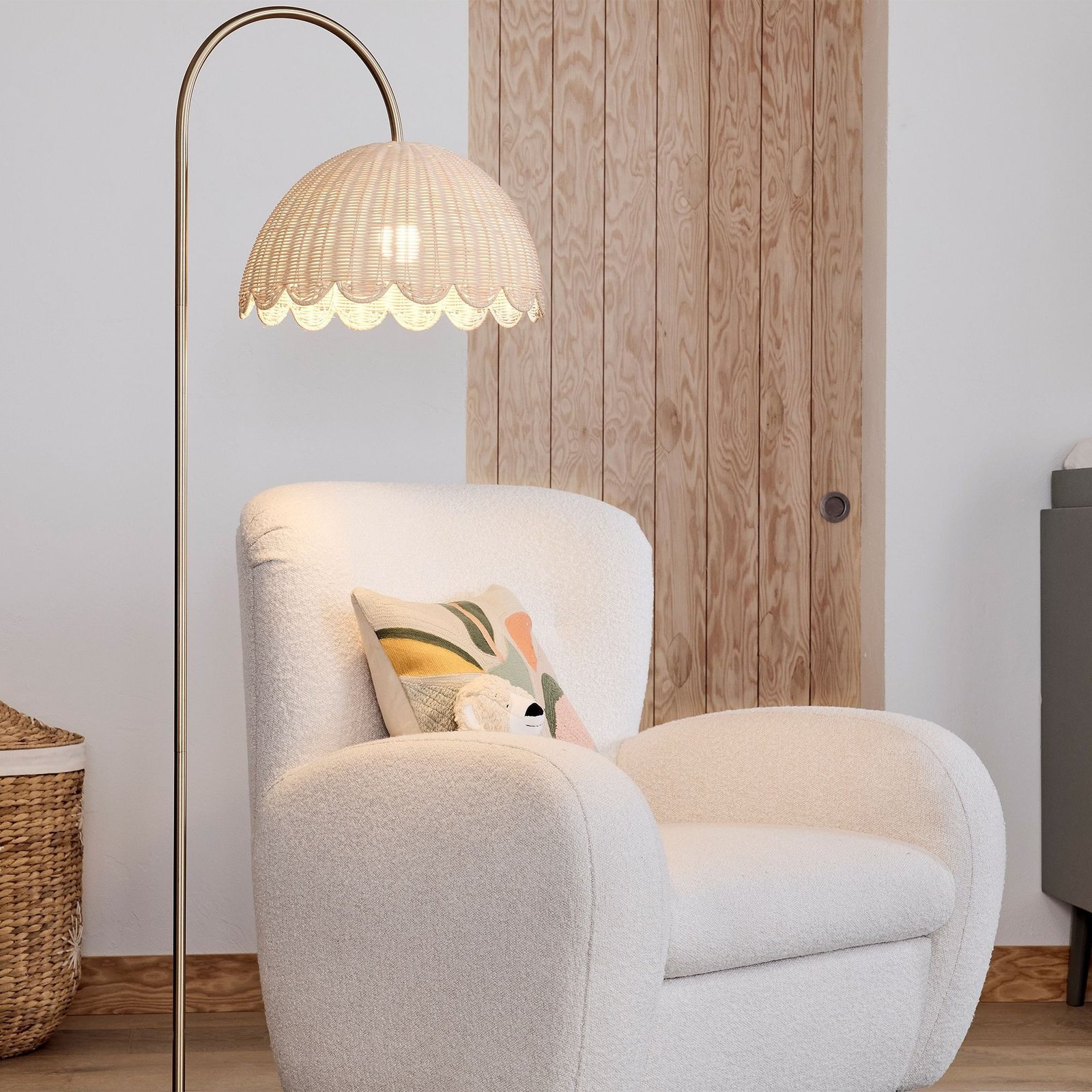
7. The Rattan or Woven Floor Lamp: Texture as a Design Language
Interior design increasingly speaks a language of natural materials — linen, stone, wood, clay — and a rattan or woven lamp is fluent in that language.
Illuminated, the woven shade casts intricate shadow patterns across surrounding surfaces — creating light that behaves more like dappled sunlight than electric illumination. The quality of light produced is genuinely distinctive and deeply atmospheric.
These lamps are at home in rooms that lean relaxed, organic, and layered: bedrooms, sunrooms, living spaces built around comfort rather than formality.
The honest caveat: woven shades are diffusers, not directors. The light they cast is soft and ambient — beautiful for atmosphere, insufficient for focused tasks. Know which you need before committing.
In the right context, paired with a floor cushion and a woven storage basket, this lamp doesn’t just fill a corner — it defines a mood.
How to Assess Your Corner Before You Shop
Before committing to any purchase, spend five minutes answering these questions honestly:
What does the corner need to do? Provide task lighting for reading? Create ambient mood? Simply add visual presence? The answer is your first filter.
What is the ceiling height? Generous ceiling height welcomes arc lamps and torchieres. Standard or lower ceilings are better served by pharmacy lamps and moderate-height tripods.
What materials and tones dominate the room? Your lamp should feel like it speaks the same material language as your existing furniture — or like a deliberate, confident departure from it. Accidental contrast is not the same as intentional contrast.
How much floor space does the corner offer? Measure it. Arc lamps and tripods require clearance. Shelf lamps and pharmacy lamps work in compressed footprints.
These four questions narrow the field considerably. The right lamp usually becomes clear once you’ve answered them.
The Layering Principle That Elevates Any Corner Lamp
The final technique requires no additional budget — only a change in approach.
A floor lamp functions best as part of a layered lighting scheme, not as a standalone source.
One floor lamp in an otherwise unlit room looks like a solution applied where none previously existed. That same floor lamp alongside a table lamp across the room — and candles at a lower level — looks like a room that was lit by someone who knows what they’re doing.
Three heights. Three sources. Floor lamp overhead, table lamp mid-height, candles at seated eye level. This vertical distribution of light creates the richness that distinguishes rooms that merely have furniture from rooms that feel genuinely lived in and considered.
Your corner lamp is the highest point. Build the rest of the room’s light around it.
The Room That’s Been Waiting for This
The corner has been patient. The room has been waiting.
You don’t need a renovation or a consultant or a month of deliberation. You need one well-chosen floor lamp that fits the specific proportions, light requirements, and aesthetic of that particular spot.
Choose the style that resonates with your room’s existing character. Measure what the corner can accommodate. Be honest about whether the primary need is functional light or visual completion.
Then place the lamp and watch what happens to the room around it.
A floor lamp doesn’t just occupy a corner.
It resolves a composition.
And when a room’s composition is resolved, you feel it immediately — in the way the space settles around you, in the ease with which guests relax into it, in the simple satisfaction of walking through a door into a room that finally feels finished.
Your corner is ready for its moment.