Effortless Kitchen Table Styling: Decor Ideas That Actually Work
Disclosure : This post may contain affiliate links or paid partnerships. I may earn compensation if you click a link or make a purchase, at no additional cost to you. See my disclosure for more info.
There’s a version of your kitchen table that you already know exists.
You’ve glimpsed it in the corner of a beautifully shot cookbook. In the background of a video call with someone whose home always seems to look just right. In the still frames of a lifestyle blog you bookmarked three years ago and never revisited.
It’s the same table, technically. But somehow it feels different. Intentional. Warm. Like someone thought about it.
The gap between that table and yours is smaller than you think.
It comes down to understanding a handful of principles that professional stylists apply on every project — principles that have nothing to do with a big budget and everything to do with a clear eye.
Here’s what they know that most people don’t.
What Makes a Kitchen Table Look “Designed” vs. Just Used
Before anything else, you need to identify the real problem.
In most homes, the kitchen table is treated as a landing zone — a surface for whatever needs somewhere to go. A fruit bowl that accumulates grocery receipts. A candle that was lit once. A vase someone gave as a gift that doesn’t match anything else.
The objects are there, but there’s no cohesion. No story connecting them.
That’s the gap between a table that’s merely occupied and one that’s been considered.
A designed table operates on three principles: visual balance, correct scale, and deliberate purpose.
Visual balance means the arrangement has a visual center of gravity. Scale means nothing is so large it dominates or so small it disappears. Purpose means every object contributes something — beauty, function, or texture — and anything that doesn’t is removed.
That’s the framework. Now let’s talk specifics.
1. Choose a Centerpiece That Lives at Eye Level
The centerpiece is the anchor of your table’s visual story. It sets the tone for everything around it.
But many people get the scale entirely wrong — choosing arrangements so tall they wall off the table into two sides rather than creating a shared, open surface.
A well-chosen centerpiece stays low. It invites the eye inward and downward, not upward. It allows people to see one another clearly, which is, after all, the whole point of gathering around a table.
Consider a hand-carved wooden bowl filled with dried botanicals or seasonal objects. A grouping of three pillar candles in earthen tones. A single terracotta herb pot that supplies both fragrance and an eventual meal ingredient.
These elements work because they feel grounded. They don’t reach for attention. They earn it quietly.
Understatement is a design virtue. Lean into it.
2. Lay a Runner to Establish Visual Continuity
One of the quietest, most effective moves in kitchen table styling is also one of the most consistently overlooked.
A table runner doesn’t just add color. It establishes a line — a visual axis — that gives your entire arrangement something to organize itself around. Without it, even beautiful objects feel random. With it, even simple objects feel placed.
A linen runner is the most versatile option — it works in a modern loft, a cottage kitchen, and everything in between. Jute and burlap bring raw, natural energy. Macramé introduces craft and texture without overwhelming.
Select a tone that contrasts gently with your table surface. The contrast creates definition. Definition creates intention.
This is the foundation on which everything else builds.
3. Compose in Odd Numbers for Inherent Visual Interest
Among the rules that designers quietly live by, few are as universally applicable as this one.
Odd-numbered groupings create visual interest. Even groupings create visual resolution. The difference sounds small but feels enormous in practice.
When your eye encounters three objects of varying heights, it doesn’t resolve them instantly. It moves between them, taking in the relationships and contrasts. This engagement makes the arrangement feel curated and alive.
When your eye encounters four identical candleholders in a row, it categorizes them immediately and moves on.
Three pillar candles on a tray is a moment. Four pillar candles in a line is inventory.
Compose in threes. Vary the heights. Let the arrangement breathe.
4. Introduce Candlelight to Transform the Table’s Character
Light changes everything in a space. Candlelight changes everything at a table.
There is a distinct quality of warmth — both literal and emotional — that candlelight brings to the table that no overhead fixture or lamp can replicate. It softens the room. It slows the pace of conversation. It transforms even the most ordinary weeknight dinner into something that feels worth being present for.
Beeswax tapers in brass or matte ceramic holders have a sculptural quality that adds beauty even when unlit. Pillar candles arranged on a natural wood or slate surface feel grounded and refined. For homes with children, high-quality flameless LED candles now replicate the flicker of real flame convincingly enough to pass casual inspection.
Use candles every evening. Not just when it counts.
Every evening counts.
5. Work With Nature Instead of the Flower Shop
One of the most persistent myths about beautiful kitchen tables is that they require regular trips to the florist.
They don’t.
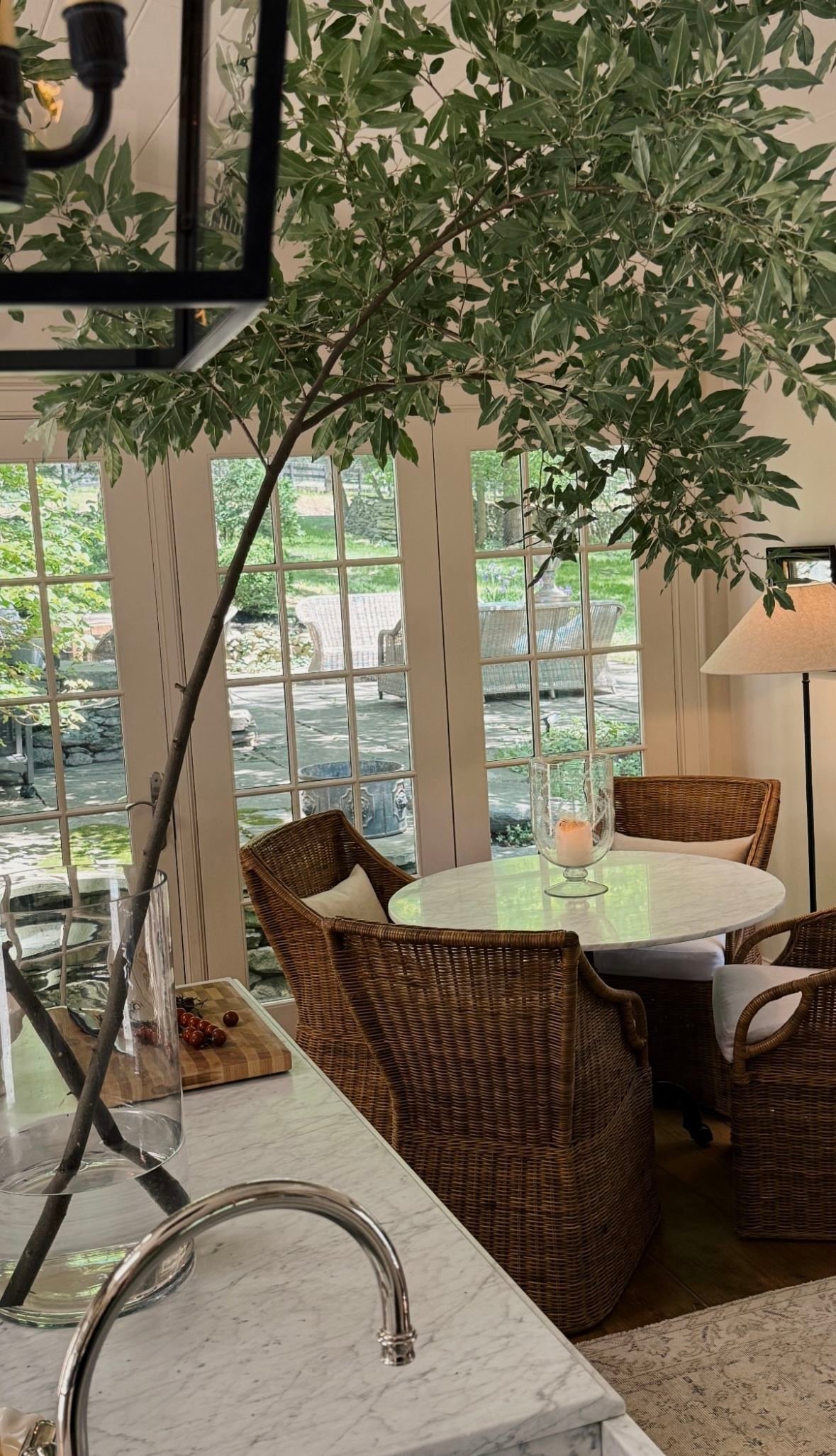
A branch of garden eucalyptus in a clear glass vessel has a kind of composed elegance that a formal bouquet can’t match. A loose handful of garden herbs in a ceramic jug smells extraordinary and looks effortlessly considered.
The natural world is the most sophisticated decorator available — and it asks for almost nothing in return.
Tie your table to the current season. Dried seed heads and warm foliage in autumn. Pinecones and stripped branches in winter. Loose-petaled blooms in spring. Citrus and bold greenery in summer.
Your table stays current. It stays alive. It reflects the world outside your window, which is one of the most grounding things a home can do.
6. Deploy a Tray to Create Instant Composition
Among the various tools available in the decorator’s vocabulary, the tray may be the single most underutilized.
A tray performs a function that nothing else quite replicates: it creates a container within an open surface. It defines a boundary that tells your eye “this grouping was composed, not accumulated.”
Take a woven or wooden tray. Place a candle, a small plant, and a handsome salt cellar inside it. The result reads as a vignette — a small, complete composition that holds its own visual weight on the table.
The same three objects placed directly on the table without containment look like they were set down and never moved.
Organic seagrass trays suit relaxed, natural interiors. Polished stone reads contemporary and refined. Weathered wood feels warm and approachable in any farmhouse or transitional space.
A tray transforms a collection into a composition.
7. Set Your Table Every Day, Not Just for Guests
Here is a habit that separates homes that feel designed from homes that only look designed when company is coming.
Using placemats at every meal — weekday breakfast included — shifts the entire energy of your kitchen.
It’s not about formality. It’s about the quiet act of telling yourself that the ordinary moments of your life are worth some visual care.
Woven rattan adds organic texture. Linen brings effortless, understated refinement. Cork or leather offers durability without sacrificing visual interest.
A charger plate under a basic dinner plate adds a layer of visual architecture to the setting — making the table feel composed without being fussy.
Extend this courtesy to yourself daily. The table is worth it. You are worth it.
8. Let the Seasons Move Through Your Table
A beautiful table that never changes eventually stops being noticed. The eye adjusts to what’s always there.
The solution is not wholesale reinvention with each season. It’s considered, small-scale evolution.
In autumn, introduce warm-toned textiles, dried botanicals, and objects in amber, ochre, and rust. In winter, shift toward evergreens, deep blues and burgundies, and the glow of more candlelight. Spring calls for fresh blooms, lighter linens, and the reintroduction of pale, airy colors. Summer brings tropical green, bright citrus tones, and open, breathing arrangements that feel as unconfined as the season itself.
Keep a dedicated storage vessel for seasonal table elements — the small objects and textiles that mark the transitions. Bringing them out and putting others away takes very little time and delivers a disproportionate sense of freshness.
A table that moves with time feels inhabited, considered, and alive.
9. Make Cloth Napkins a Non-Negotiable Daily Element
The smallest details send the clearest signals about whether a space was designed or merely furnished.
A paper napkin communicates utility. A linen napkin communicates care — about the meal, about the people eating it, about the space they’re eating in.
Cloth napkins require no special occasion to justify. They are machine washable. They improve with use, growing softer and more supple with every cycle. And in a range of natural tones — warm ivory, sage, oyster, clay — they complement nearly any table setting imaginable.
Pair them with a simple napkin ring and the effect moves from pleasant to considered.
The practical benefit: you’ll stop buying paper napkins entirely. Easier on the budget. Easier on the planet.
A design improvement with no downside.
10. Edit Until the Table Can Breathe
Of all the principles in this guide, this one produces the most dramatic results — and requires the most counterintuitive discipline.
Take something away.
Once you’ve assembled your table decor, step back far enough to see the whole picture. Look at it with fresh eyes. Then remove at least one object.
In virtually every case, what remains is better than what you started with.
The instinct when decorating is accumulation — more objects, more variety, more fullness. But the most elevated tablescapes you’ve ever admired share a quality of restraint. There is open space. Room between objects. A sense that the table is ready for life, not buried beneath decor.
A table with breathing room looks confident. It communicates that what’s there was chosen carefully, because anything unnecessary was removed.
That is the essence of designed space: not adding until it’s full, but editing until it’s right.
The Table You’ve Always Wanted Is Closer Than You Think
You don’t need a renovation to have a kitchen table that feels beautiful.
You need a runner. A tray. A candle or two. A handful of greenery. The discipline to remove one thing after you think you’re done.
These principles work in a studio apartment and in a farmhouse kitchen. In a rental and in a home you’ve owned for decades. On a table that cost hundreds and one that came from a secondhand shop.
The work is small. The daily return is significant.
Start with one idea from this list. Build carefully. Let the table evolve.
The most beautiful spaces are never finished — they’re tended. And the act of tending them is its own reward.
Your table is ready. So are you.
🔍 Focus Keyphrase: kitchen table decor ideas
📌 SEO Title (< 60 chars): Must-Have Kitchen Table Decor Ideas to Elevate Your Home
🔗 Slug (< 60 chars): must-have-kitchen-table-decor-ideas
📝 Meta Description (< 155 chars): Discover the best kitchen table decor ideas to elevate your space. From centerpieces to seasonal swaps, transform your table today.