Raw & Refined – 39 Industrial Living Room Upgrades That Bring Real Warmth
Disclosure : This post may contain affiliate links or paid partnerships. I may earn compensation if you click a link or make a purchase, at no additional cost to you. See my disclosure for more info.
Every time you walk into your living room, something nags at you.
Not a crisis — more of a quiet dissatisfaction. The space is fine. But “fine” isn’t what you had in mind when you started imagining something better.
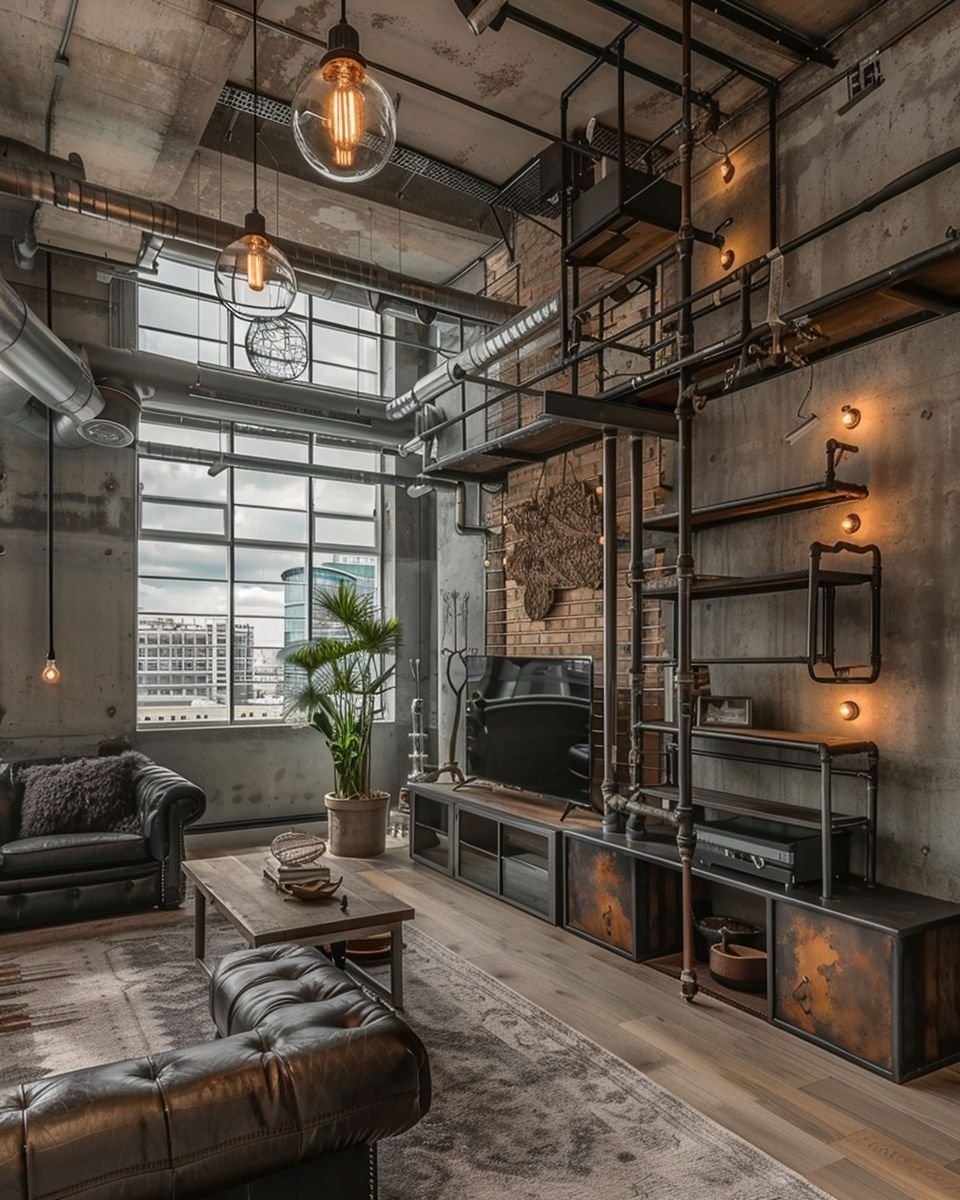
Industrial design showed up in your search results and you felt it. Salvaged wood, raw concrete, exposed metal, factory-style lighting. Something authentic and undecorated in the best possible sense.
But the rooms you keep saving look inhabited by no one in particular. Visually arresting. Emotionally hollow.
“The style makes sense to me. But those rooms feel like sets, not homes.”
That tension is real. And the solution is simpler than you think: the industrial rooms that actually feel good are the ones that layered warmth into every decision. Softness wasn’t an afterthought — it was a core material alongside iron and concrete.
You can do both. You can have the grit and the comfort.
These 39 ideas show you how, one concrete step at a time.
Building a Lighting System That Creates Genuine Atmosphere
Too many industrial rooms fall into the single-pendant trap.
One dramatic fixture. Click. Done. Except the room still feels flat.
That’s because atmosphere isn’t about brightness — it’s about distribution. Multiple sources, multiple heights, multiple moods.
1. Group several pendant fixtures at different drop heights above the main area.
Three to five pendants suspended at staggered heights creates a dynamic overhead composition rather than a single focal point.
2. Position a posable floor lamp in matte black beside a reading chair.
Directional floor lamps serve double duty: practical task lighting and sculptural presence when not in use.
3. Mount brass-toned wall sconces on either side of the sofa.
Brass is the secret weapon in industrial lighting. It tempers the harshness of black metal and adds a warm, almost vintage quality to the room.
4. String exposed filament bulbs on heavy black wire across the ceiling.
Not fairy lights — actual filament bulbs with visible tungsten suspended on a serious cable. Against a high ceiling, it’s one of the most striking and affordable lighting moves you can make.
5. Use a grouping of thick pillar candles on a metal tray as an ambient source.
You cannot replicate what open flame does to a room. A tray of pillar candles shifts the mood entirely and takes seconds to arrange. Warmth, visible. Warmth, moving.
Natural and Living Elements — The Fastest Route Out of Cold
Want the simplest prescription for an industrial room that feels sterile?
Add something alive.
Organic forms and natural materials interrupt hard-edged monotony instantly and without drama.
6. Anchor an empty corner with a tall indoor plant.
A snake plant, monstera, or olive tree in a woven planter addresses dead vertical space with immediate biological presence.
7. Cluster smaller plants on a metal wall shelf.
Three to five species in different pots. A variety of leaf shapes and sizes. It becomes a small living installation that animates an otherwise flat surface.
8. Use dried arrangements in a stoneware vessel for low-maintenance texture.
Pampas grass, cotton branches, or dried seed pods deliver the silhouette and texture of botanicals without requiring water or light.
9. Scatter stone objects — a marble dish, a raw crystal bookend — as accent pieces.
Stone anchors the natural material story alongside iron and timber. It adds grounding weight without cluttering the visual field.
Architectural Decisions That Define Everything Else
Everything decorative sits on top of architecture. Get the structural choices right and you’re working with the room. Get them wrong and you’re fighting it forever. These decisions come first, because they set the conditions for everything else.
10. Reveal one brick wall and leave the rest soft and neutral.
Brick does its best work as an accent — one wall of it, surrounded by understated plaster in warm white, creates contrast without visual chaos.
11. Treat concrete floors with a sealer or polish before considering them done.
Sealed concrete looks finished. Raw concrete looks abandoned. The treatment takes the material from structural oversight to deliberate design choice.
12. Lay wide-plank reclaimed wood floors for warmth at ground level.
Salvaged timber carries the texture and history that concrete can’t. As a floor covering, it grounds the room and keeps it from feeling cold underfoot.
13. Choose oversized black steel-frame window systems.
Slim iron sash lines are industrial shorthand and an architectural gesture that brings in maximum light while keeping the aesthetic tightly focused.
14. Leave structural ceiling beams exposed and stain them in a warm tone.
Raw beams read industrial the moment eyes land on them. An amber, walnut, or honey stain wraps that rawness in warmth and makes them feel considered rather than overlooked.
15. Unify exposed mechanical systems with a single coat of flat black paint.
Visible pipes and ducts become architectural features — not industrial accidents — when treated with intentional matte black rather than left in their utilitarian state.
Furniture That Mixes Toughness With Comfort
The furniture selection is where most industrial rooms go wrong.
Everything rivet-studded and metal-framed — no textiles, no softness, nothing that invites you to stay.
The corrective is simple: pair every hard material with something that gives.
16. Ground the seating area with a large leather sofa in a warm cognac or tobacco shade.
Full-grain leather on a generously proportioned sofa is the single most effective warmth anchor in an industrial room. It improves with age and invites people to stay.
17. Use a slab or live-edge wood coffee table at the center.
Natural wood edges push back against the geometric sharpness of industrial materials. A piece with real character — knots, figure, uneven silhouette — wins every time over a factory-clean version.
18. Pull in upholstered chairs with depth and tactile appeal.
Boucle, heavy linen, velvet — the choice of fabric matters more than the chair’s exact silhouette. Seat them across from the sofa to balance softness on both sides of the space.
19. Set an iron-and-wood open shelving unit against a wall and edit it mercilessly.
Books spaced out, one ceramic piece, a trailing plant. Breathing room on the shelves reads as confident rather than spare.
20. Introduce a worn leather trunk as a side or accent table.
A trunk with real patina tells a story. It also hides clutter and makes the space feel assembled rather than decorated.
21. Bring in a large woven pouf or floor cushion near the seating.
Chunky and tactile, a pouf breaks the rigidity of surrounding surfaces. It also signals that this room is for actual use, not photography.
Color Choices That Inject Warmth Without Diluting the Style
Industrial doesn’t mean colorless. That misconception produces rooms that feel punishing rather than purposeful.
“But isn’t the whole palette just gray and black?”
Only if you want the room to feel like a storm drain.
Color warmth needs to be sewn into the choices from the beginning.
22. Paint walls in warm white rather than any shade of cool gray.
A warm-toned white handles natural light beautifully and avoids the icy quality of blue-undertoned neutrals in rooms with limited sun.
23. Work rust, ochre, and terracotta through decorative objects.
A terracotta planter, an ochre bowl, a burnt sienna throw. These tones share visual ancestry with brick, iron, and raw timber and feel completely native in their company.
24. Let green read throughout the room as a recurring presence.
Plants handle much of this automatically. Add depth with an olive or sage cushion or throw. Green provides visual relief and biological warmth simultaneously.
25. Reserve matte black for specific accents, not the whole room.
Frame edges. Lamp bases. A single tray. A few cabinet pulls. Matte black works as emphasis, not atmosphere. Use it to define, not to dominate.
Finishing Touches That Raise the Overall Level
The gap between a room that’s “almost there” and one that genuinely impresses usually comes down to these small calls.
Low effort. High visibility. Entirely worth it.
26. Replace builder-grade switch plates with matte black or aged brass alternatives.
Fast, cheap, and instantly effective at pulling the room out of generic territory.
27. Turn books spine-inward on open shelves.
Uniform paper-white edges replace the visual noise of colorful spines with a calm, tonal texture that reads as intentional.
28. Build a small coffee table composition on a wooden or stone board.
One board as the base. A candle, a small plant, one object with weight. A defined, focused composition is always more powerful than scattered objects.
29. Standardize all hardware finishes across the entire room.
Polished chrome and industrial design are incompatible. Matte black, brushed iron, or aged brass — standardize to one and apply it with discipline throughout.
30. Layer a character-rich rug on top of a grounding jute base.
The jute provides natural texture and holds the composition together. A faded vintage piece on top adds history and personality. Two layers, combined effect far greater than either alone.
31. Keep one piece that shows genuine wear in the room.
Industrial style’s emotional honesty comes from imperfection. A worn edge, a faded surface, a visible repair. It’s what tells you a real person lives here.
Textiles That Convert the Room From Display to Home
Imagine the room stripped of every soft furnishing.
What you have left is not a home. It’s a very expensive storage unit.
Textiles are the evidence of habitation. Without them, the room can’t breathe.
32. Anchor the seating area with a large jute or sisal rug.
Bigger than instinct suggests. Front legs of all major pieces should sit on top of it. A properly scaled rug pulls the room together and adds a full layer of tactile warmth from the ground up.
33. Drape a thick knit throw over the sofa.
The simplest gesture in the list. The impact is entirely disproportionate to the effort. One throw signals: come in, sit down, stay awhile.
34. Combine linen and wool cushions in layered earth tones.
Don’t match. Combine. Ochre against rust. Cream against slate. Varied sizes and weaves. The result should suggest gradual accumulation rather than a single shopping trip.
35. Hang floor-to-ceiling linen curtains in a warm, natural tone.
Even against strong industrial architecture, curtains introduce a softness that the bones of the room can’t provide. Natural linen in flax or oatmeal, hanging full-length, achieves that with effortless grace.
Hanging and Displaying Things With Purpose
Brick and concrete walls can carry their own visual weight. Bare drywall cannot.
Without art or objects, standard plaster reads as an oversight, not a design decision.
36. Choose one large abstract work framed in a minimal industrial frame as the main statement.
One large-scale piece above the sofa carries more authority than a cluster of small works. A raw metal or stripped timber frame maintains the aesthetic without fussiness.
37. Build a multi-piece gallery wall using mismatched frame materials.
Iron, natural wood, aged brass frames in varying sizes. The visual story that emerges from the combination is richer than any single piece can create alone.
38. Position a substantial metal-framed mirror or a statement gear clock as a functional art piece.
Mirrors extend the perceived space and reflect light. Exposed-movement clocks are wall sculpture that happens to tell time. Both earn their place beyond pure decoration.
39. Lean artwork on a shelf or mantel rather than fixing it to the wall.
Propped art is casual, evolving, and entirely on-brand for industrial design. It says the room was built by someone with taste, not installed by committee.
Your Living Room Is Ready When You Are
This probably isn’t the first list you’ve read on this.
You’ve already made some moves. Added a few pieces. Changed a few things. The direction is right, but the feeling hasn’t fully arrived.
That’s because warmth in an industrial room is not a product. It’s a relationship between materials. Soft against hard. Warm against cool. Organic against geometric. Each contrast strengthens the room.
You don’t need all 39 ideas. Pick the ones that fit your room, your taste, and your current situation. Start one at a time.
The moment when it clicks — when you walk in and the room finally feels like yours — is a lot closer than you think.
Find one idea on this list and act on it this week.
That’s how the room gets built. One right decision at a time.
🔍 Focus Keyphrase: industrial living room ideas
📌 SEO Title: 39 Industrial Living Room Ideas That Feel Like Home
🔗 Slug: industrial-living-room-ideas
📝 Meta Description: Discover 39 industrial living room ideas that balance raw style with real warmth. From lighting layers to textiles — make the look truly livable.