How to Turn Your Backyard Into a Jacuzzi Oasis: 09 Ideas That Actually Work
Disclosure : This post may contain affiliate links or paid partnerships. I may earn compensation if you click a link or make a purchase, at no additional cost to you. See my disclosure for more info.
Picture your ideal evening at home.
Not the one where you collapse on the couch and doom-scroll until midnight. The other kind. The one where you actually feel restored by the end of it.
For a lot of people, that image involves warm water, soft light, and the quiet sounds of an evening outside.
An outdoor jacuzzi can make that a Tuesday night, not just a vacation fantasy.
And you don’t need a sprawling estate to do it. You need a realistic plan and the right design choices. We’ve pulled together nine of the most effective approaches — each one adaptable to different yards, different budgets, and different definitions of what “backyard luxury” means to you.
Start with some quality outdoor seating and string lights to frame the space before the jacuzzi even arrives.
The Real Reason Your Backyard Isn’t Working for You
Most outdoor spaces fail for the same reason: there’s nothing compelling about them.
Not in a structural sense — in a functional one. There’s nowhere to go and nothing to do that makes being outside feel different from being inside.
A jacuzzi solves this by becoming the destination. The thing that makes stepping outside feel purposeful. The reason you’re out there instead of inside under the air conditioning.
Once you have that anchor, everything else — the lighting, the landscaping, the furniture — starts to make sense and find its place.
Here’s how to build it right.
1. The Sunken Jacuzzi That Looks Like It Belongs in a Resort
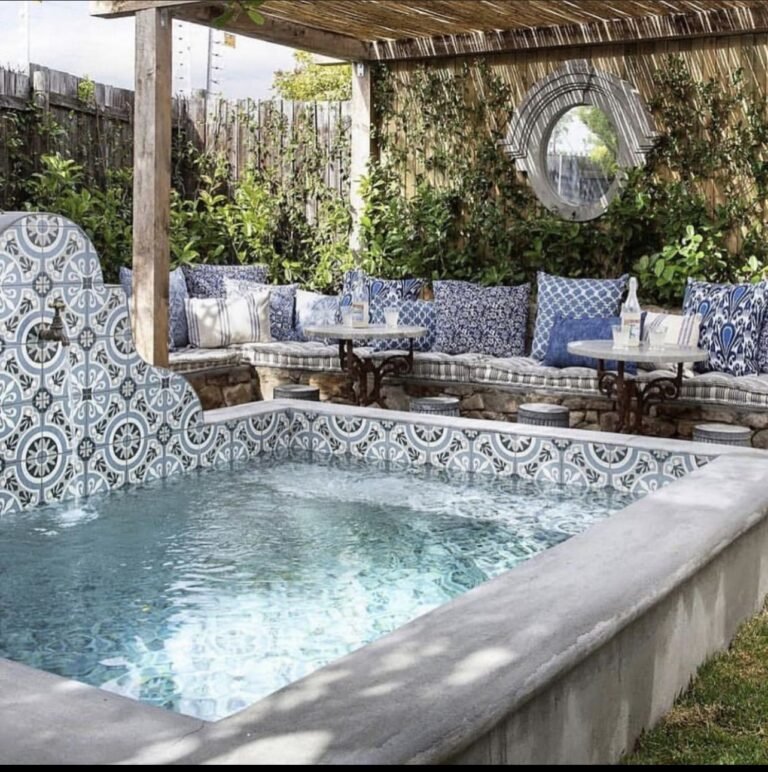
The sunken jacuzzi is the design choice that photographers love and visitors remember. Rather than sitting atop your deck or patio, it’s set into the ground — flush with the surrounding surface, flush with the architecture.
What you get is seamlessness. The yard flows right to the water’s edge without interruption.
Getting into the tub means stepping down, not climbing up — a subtle difference that makes the whole experience feel more spa-like.
Yes, installation is more complex than a standard hot tub drop-in. Excavation, drainage, and structural preparation are involved.
But the finished result consistently looks like it cost more than it did. Especially when you surround it with natural stone or composite decking and line the edges with recessed lighting that glows beautifully after dark.
2. The Pergola-Covered Jacuzzi for Year-Round Luxury
Here’s a scenario that plays out more often than people expect: you install a beautiful jacuzzi, enjoy it enthusiastically for a few weeks, and then a heat wave or a rainy stretch sidelines the whole thing.
Without overhead coverage, your usage becomes weather-dependent. And weather is unreliable.
A pergola is the most elegant solution. It shades the area in summer, deflects light rain, and with retractable side panels or an adjustable louvered roof, creates an outdoor environment you can actually inhabit year-round.
The material you choose sets the tone. Cedar and redwood feel warm and traditional. Powder-coated aluminum or steel reads as clean and modern.
Hang pendant lights from the overhead beams, drape outdoor fabric on the sides, and the whole area transforms from “a hot tub outside” into a room that happens to be outdoors.
3. The Japanese-Inspired Soaking Tub Setup
Not everyone needs jets and LED light shows. Some people want to actually relax.
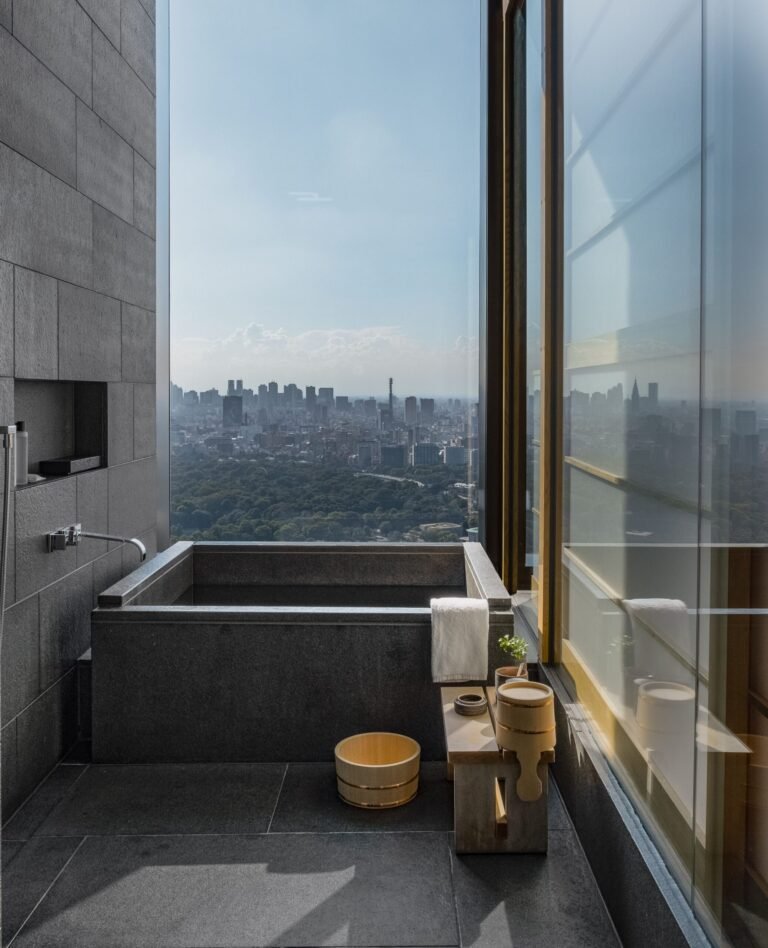
The Japanese soaking tub — or ofuro — is built around that philosophy. Deeper than a standard tub, narrower than a hot tub, and designed for one or two people sitting in contemplative silence rather than party mode.
The surrounding design follows the same logic. Smooth stones. Bamboo. A single carefully chosen plant. Minimal visual noise, maximum atmospheric effect.
For smaller yards, this format is a genuine gift. A compact cedar or hinoki soaking tub with a few planter boxes arranged thoughtfully around it occupies very little space while creating a sense of total retreat.
Think of it less as a backyard feature and more as a daily mindfulness practice with better infrastructure.
4. The Deck-Integrated Jacuzzi That Maximizes Space
The most common spatial mistake in backyard design is treating the jacuzzi as furniture — something you place in the yard and arrange other things around.
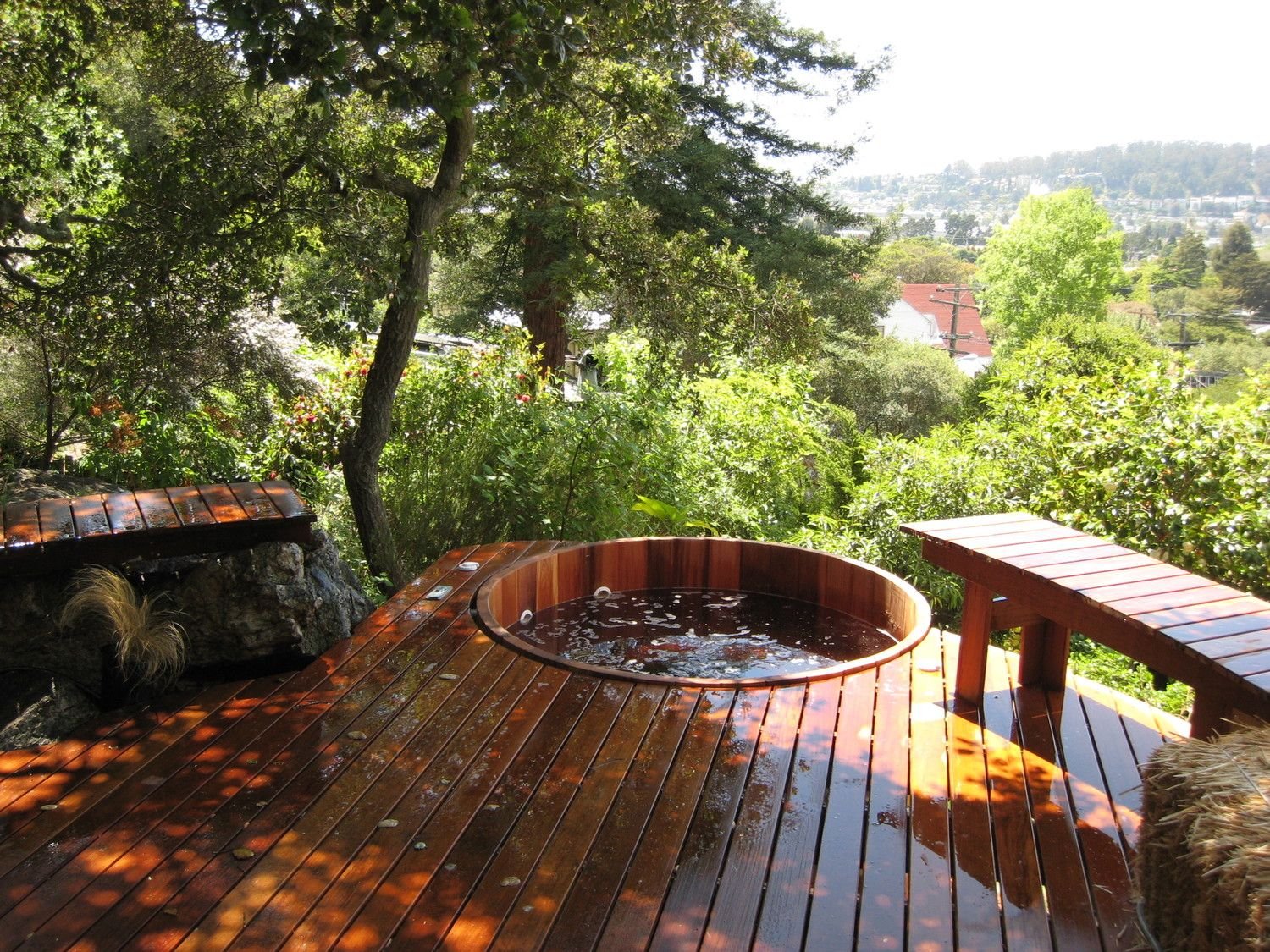
When you integrate the jacuzzi into the deck structure itself, it stops being an object in the space and starts being part of the space. The difference is dramatic both visually and functionally.
The deck is designed around the tub from the start. Built-in bench seating lines the surrounding area. Planter boxes define the perimeter. A narrow ledge at tub height holds your drink within arm’s reach.
Multi-level decking pushes this further. Drop the tub one level below the main deck, and your compact yard suddenly reads as layered, intentional, and substantial.
5. The Fire-and-Water Combo That Stops People in Their Tracks
Fire and water have been paired in outdoor design for centuries because the combination works at a level that’s almost instinctive. Warmth and movement. Glow and steam. Opposing elements in conversation.
Placing a fire pit or a fire table within visual distance of your jacuzzi creates a scene with genuine atmosphere. Gas-fueled options provide the most reliable and low-maintenance flame.
Position for both aesthetics and safety: close enough to appreciate from the water, separated from the tub by a defined buffer of stone or hardscape.
The detail that elevates this from “two things near each other” to a designed space: use the same stone or material in both surrounds. That single decision creates continuity that looks intentional and polished at any budget level.
6. The Garden-Wrapped Jacuzzi for Total Privacy
The most underrated element of an outdoor jacuzzi is privacy. Without it, people hesitate to use the thing they spent money installing.
The instinctive solution is a privacy fence. But a fence is a blunt instrument — it closes the space down visually and can make a yard feel smaller and boxier.
Planted screening does the same job without those drawbacks. Tall ornamental grasses sway and catch the light. Dense evergreen hedges provide year-round coverage. Columnar trees create vertical interest without spreading into the yard. Climbing plants on a trellis create a living curtain that fills in beautifully over time.
Layer your plantings with intention — lower species at the front, taller ones behind — and the result is a screen that feels designed rather than defensive. Surrounded by greenery, the jacuzzi area becomes genuinely secluded. No fences. No walls. Just nature doing the work.
7. The Rooftop or Balcony Jacuzzi for Urban Dwellers
Living in a city or a building without dedicated outdoor ground space doesn’t mean forgoing an outdoor jacuzzi entirely.
Rooftop terraces and reinforced balconies are legitimate installation sites — provided the structural questions are answered properly first.
And that’s the essential first step: get a qualified structural engineer to assess load capacity. A filled jacuzzi is heavy. This isn’t something to estimate or approximate. It’s a calculation that needs professional verification.
Once you have that clearance, the design opportunities are excellent. A compact two-person tub on an urban rooftop with city views delivers an experience that genuinely rivals a luxury hotel amenity — one you have access to every evening at no additional cost.
Keep the surrounding design minimal. Lightweight planters add greenery without loading the structure. Solar lanterns and a quality outdoor rug define the space without crowding it. Up high, the goal is curated clarity, not abundance.
8. Smart Lighting That Turns Your Jacuzzi Area Into a Night Scene
Lighting is where most outdoor jacuzzi setups leave serious atmosphere on the table.
A single overhead light floods the area with flat, even brightness. It’s practical. It’s also aesthetically inert.
What creates atmosphere is layered light at multiple heights — the same approach used in well-designed restaurants and hotel spaces.
At the ground level, LED strip lighting along the deck and pathway edges creates a warm baseline. Solar stake lights in the planted areas add dimension. Weatherproof string lights overhead and lanterns at eye level complete the vertical range.
Add the built-in chromotherapy lighting present in most contemporary jacuzzi models — soft underwater color that shifts gradually — and the resulting nighttime scene is something most guests will remember long after the evening ends.
9. The All-Season Setup with a Weather-Proof Enclosure
For homeowners in regions with genuine winters, an exposed outdoor jacuzzi risks becoming a three-season amenity at best.
The solution is structured protection. Options range from a basic quality cover combined with a retractable windscreen on the prevailing-wind side, all the way to a fully enclosed structure with a polycarbonate roof and insulated walls.
The right level of enclosure depends on your climate, your budget, and how often you realistically want to use the space in cold weather. But the guiding principle is consistent: an outdoor jacuzzi you use eleven months a year is a fundamentally better investment than one you use four.
Design any enclosure to feel continuous with the jacuzzi installation. Matching materials and proportional thinking keep the result looking considered rather than assembled.
The Best Time to Start Was Last Year. The Second Best Is Now.
There’s a version of this project that gets planned indefinitely and never built. Most people know someone whose backyard renovation has been “almost ready to start” for years.
Don’t be that yard.
You don’t need everything figured out before you begin. You need a starting point that makes sense for where you are right now — your actual budget, your actual yard, your actual lifestyle.
Pick the idea that resonates most from this list. Build it with intention. The rest follows.
Your outdoor furniture will look better surrounding something worth sitting next to. The string lights will mean more when they’re illuminating a space you actually use.
Start where you are. Build what you can. The backyard you keep imagining is closer than it feels.