33+ Coffee Table Designs Interior Designers Actually Recommend
Disclosure : This post may contain affiliate links or paid partnerships. I may earn compensation if you click a link or make a purchase, at no additional cost to you. See my disclosure for more info.
In interior design, the coffee table occupies a position of unusual importance.
It is not the largest piece in the room. It is rarely the most expensive. But it is the one piece that every person in the space interacts with, visually orients around, and reaches toward throughout the course of any given day.
Get the coffee table right and the room locks into place. Get it wrong and no amount of expensive upholstery or thoughtful lighting can compensate for the imbalance.
This is not a problem of taste. It is a problem of information. Most people choose coffee tables without knowing the rules that govern how they function within a room. This guide provides those rules, along with 33+ carefully selected options across every relevant category.
Enduring Classics Worth Every Penny
These are the designs that interior professionals return to repeatedly because they solve the problem reliably and without introducing new ones. They have proven themselves across generations of changing tastes.
1. Solid wood rectangular table. Hardwoods—walnut, white oak, teak—with clean structural lines and no surface decoration. This is the typological foundation of the coffee table. It anchors any room without competing with it.
2. Round marble-top table. Natural stone—particularly Carrara or verde marble—on a refined metal base. The material introduces visual weight and texture while the curved profile counters the linearity of most upholstered furniture.
3. Mid-century modern table. Originating in mid-twentieth-century Scandinavian and American design, this typology remains in production because its proportional relationships are genuinely optimal. Tapered legs, reduced mass, horizontal emphasis.
4. Oval tulip-base table. The pedestal base eliminates the visual complexity of four legs and produces a silhouette that reads as sculptural. The oval or round top integrates naturally with curved sectionals.
5. Parsons-style coffee table. Conceived at the Paris design school, the Parsons table achieves visual presence through proportion and material rather than decorative detail. Exceptionally adaptable across interior styles.
6. Traditional turned-leg table. For interiors emphasizing heritage, warmth, and material continuity—antique furnishings, natural textiles, muted palettes—a turned-leg table in a well-chosen wood finish provides exactly the correct period register.
Distinctive Centerpieces for the Discerning Eye
The following selections are for rooms that have a defined identity and can support a strong focal element at the center.
Each of these tables functions as a design statement. Used correctly, a single strong piece of this kind can resolve the character of an entire room.
7. Live-edge wood slab table. The preservation of the wood’s natural edge produces an object that is genuinely unique and impossible to replicate at scale. The contrast between raw organic form and refined interior context is the source of its considerable power.
8. Hammered brass drum table. The hammered texture distributes light across the brass surface in a way that flat finishes cannot achieve. The cylindrical silhouette is architectural and self-contained.
9. Black concrete table. Cast concrete carries a material honesty that reads as sophisticated in the right context. The density and permanence of the piece communicates deliberate intention.
10. Sculptural travertine table. The natural variation in travertine—its pitting, its tonal shifts, its geological memory—makes each piece unlike any other. The soft, irregular forms associated with contemporary travertine design integrate beautifully with organic interior palettes.
11. Bold lacquered color table. High-gloss lacquer in a strong, unexpected color introduces chromatic contrast that can reorganize a room’s visual hierarchy. This approach requires confidence, but executed correctly it is transformative.
12. Vintage steamer trunk. Antique trunks introduce authentic material history and artisanal quality. The functional depth provides concealed storage that the exterior gives no indication of.
Functional Tables Designed for Modern Living
Contemporary living demands that furniture serve multiple purposes without requiring compromise on either. The following options have been engineered for exactly that.
13. Lift-top coffee table. The adjustable surface mechanism provides ergonomic working height on demand, with a secondary compartment that manages hidden storage needs. The most versatile single piece for households where the sofa functions as a workspace.
14. Coffee table with drawers. Integrated drawers establish dedicated, contained spaces for the items that would otherwise migrate across every surface in the room. The organizational clarity this introduces is disproportionate to the physical addition.
15. Open-shelf coffee table. The lower shelf creates a secondary display or storage tier without increasing the footprint. Books, trays, plants, and baskets can occupy this level while the primary surface remains unencumbered.
16. Basket coffee table. The woven basket with rigid lid is an elegant solution to storage visibility. The interior accommodates substantial volume. The exterior presents as considered, textured decor.
17. Ottoman with a tray on top. The upholstered ottoman with internal storage and surface tray represents a considered integration of three functions. In casual living rooms especially, this flexibility is consistently valuable.
18. Apothecary-style table with small drawers. The grid of small individual drawers provides granular organizational capacity while adding a layer of visual complexity that functions as a design element in its own right.
Space-Conscious Solutions for Compact Rooms
Smaller rooms reward precision. Every piece must earn its place and justify its footprint. These options are specifically proportioned for rooms where generous floor area cannot be assumed.
19. Nesting tables. The nesting configuration provides full storage efficiency at rest and expanded surface area on demand. This is the rational solution for rooms that need to function differently at different times.
20. Narrow oval coffee table. The elongated oval provides substantial surface area while the absence of corners improves circulation flow and removes the physical hazard of protruding angles.
21. Acrylic or lucite table. The near-transparency of acrylic eliminates the visual displacement that conventional tables impose on a small room. The furniture occupies physical space without claiming visual territory.
22. C-shaped slide-under table. The cantilevered C-profile positions the surface at usable height without requiring any independent floor footprint. A technically sophisticated solution for the most constrained spaces.
23. A slim console used as a coffee table. The unconventional application of a console table in front of the sofa provides usable surface area with a fraction of the depth imposed by a standard coffee table.
Artisan Materials With Genuine Character
The following materials distinguish themselves from conventional options through their production origin, their physical properties, or their visual rarity. Each one carries an authenticity that manufactured alternatives cannot approximate.
24. Petrified wood. Fossilized plant material in which the original organic structure has been replaced by mineral over geological time. The resulting surface is both structurally stable and visually unlike anything produced industrially.
25. Terrazzo. A composite material with origins in fifteenth-century Venetian craftsmanship. The aggregate inclusions produce a surface of controlled visual complexity that rewards close inspection without overwhelming at distance.
26. Rattan or woven cane. The open weave introduces texture and visual lightness simultaneously. Rattan ages well and responds to its surroundings stylistically—reading as coastal, Nordic, or bohemian depending on context.
27. Smoked glass with blackened steel. The combination of tinted glass and darkened metal creates a surface quality that is precise, contemporary, and quietly assertive. Best deployed in rooms with a clear formal sensibility.
28. Hand-poured resin. Resin casting allows the creation of surfaces that simulate natural materials or exist as abstract compositions entirely their own. Each piece is inherently unique.
29. Ceramic or hand-plastered. Forms produced by hand retain the subtle irregularities of their making. The matte finishes associated with contemporary ceramic and plaster work integrate naturally with mineral, organic palettes.
Innovative Arrangements Designers Swear By
The rectangular coffee table positioned symmetrically before the sofa is a convention, not a rule. The following configurations demonstrate more considered approaches to the same functional brief.
30. Two matching side tables pushed together. The pairing creates a unified surface when combined and separates into independent use pieces as needed. The formal flexibility exceeds what any single table can offer.
31. A cluster of three small stools. Grouping stools of consistent material at varying heights produces an arrangement that reads as sculpture and converts to additional seating on demand.
32. A thick butcher block slab on hairpin legs. The DIY construction allows for exact dimensional customization at a cost well below comparable retail options. The result communicates craft and intention.
33. A garden stool as a mini coffee table. The ceramic garden stool, deployed in an interior context, introduces an unexpected material register and works particularly well as a side surface beside low sofas or reading chairs.
The Art of Coffee Table Styling
Furniture selection and interior styling are two distinct disciplines that together produce a finished room. A well-chosen table styled carelessly will underperform a mediocre table styled thoughtfully.
These principles govern effective coffee table styling at a professional level.
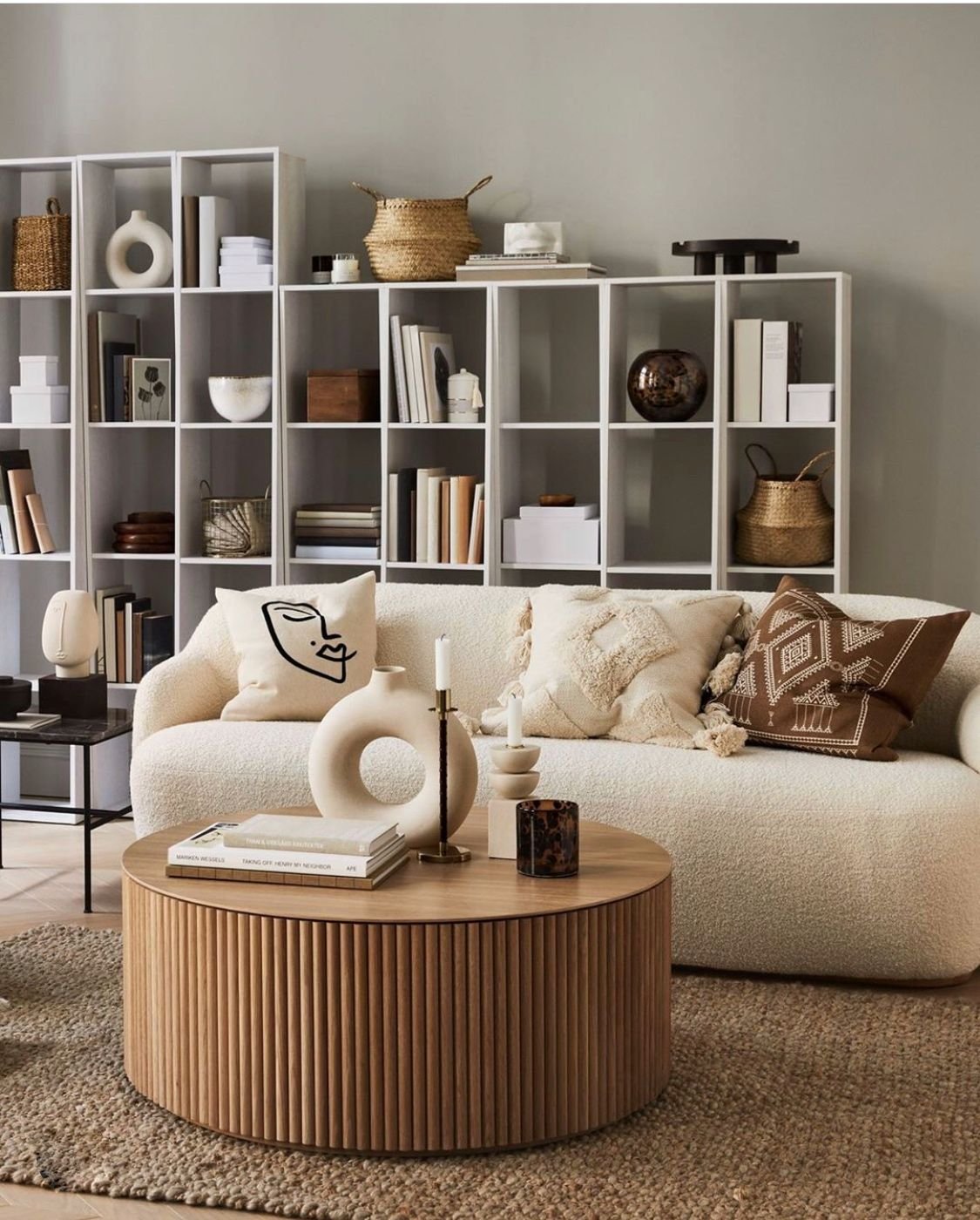
Establish containment with a tray. A decorative tray on the table surface defines a bounded visual zone. Objects within the tray read as a curated composition. Objects outside it read as clutter regardless of their individual quality.
Compose in odd numbers. Three elements of differentiated height always produce a more dynamic arrangement than even-numbered groupings. The asymmetry introduces visual tension that registers as intentional.
Incorporate organic material. A vase with cut flowers or botanicals, a small living plant, or a cluster of dried stems introduces an element that no designed object can replicate. Organic material signals habitation and produces warmth that inanimate objects cannot generate.
Create vertical variation with books. Stacked large-format volumes create a plinth at controlled height. A smaller object placed on top introduces the vertical contrast that flat arrangements lack.
Protect negative space. The unoccupied surface area around an arrangement is as compositionally significant as the objects themselves. Overcrowding eliminates the breathing room that makes each element legible.
Proportion and Scale: The Rules That Matter
Proportion errors are among the most common and most correctable problems in living room design. These four guidelines address the issues seen most frequently.
Vertical relationship. The table height should correspond to sofa cushion height or fall one to two inches below. A table that rises above the cushion line creates an ergonomic and visual imbalance.
Horizontal scale. The table length should reach approximately two-thirds of the sofa’s total length. A table that exceeds this ratio dominates the seating group. One that falls significantly short reads as undersized and disconnected.
Clearance distance. A distance of 14 to 18 inches between the table edge and the sofa front allows comfortable movement and practical reach. Outside this range in either direction, one or the other is compromised.
Formal correspondence. Sectional arrangements are best resolved by round or square tables that address the interior angle. Linear sofas are typically better served by rectangular or oval tables that echo the sofa’s own directionality.
A note on material mixing.
The coffee table need not match side tables or other furniture. Intentional material contrast—wood against metal, stone against upholstery—introduces visual complexity that makes a room feel designed rather than assembled from a single source.
Maximizing Value at Every Price Point
The persistent assumption that a more expensive coffee table produces a better result is one of the more reliable misconceptions in furniture purchasing.
Outcome is determined by suitability, not cost. A table that fits the room correctly in every relevant dimension will always outperform a more expensive table that does not.
The relevant dimensions are: appropriate height and length relative to the sofa, a material suited to actual patterns of use, a silhouette that complements the room’s formal character, and a style that maintains coherence with the existing interior. When these four criteria are met, investment level becomes a secondary consideration.
An Investment Your Living Room Deserves
This guide has covered more than 33 options across style, function, material, and scale.
It has covered the proportional principles that determine whether a table functions in a room. And the styling practices that determine whether the room feels finished.
The decision now requires only one thing: a willingness to act on the information rather than deferring it.
The room you want to inhabit is not a renovation project. It may be one well-chosen piece away from working correctly.
Identify the table that fits your room. Acquire it. Style it with intention. The transformation you have been postponing may be closer than you realize.