Elevate Your Indoor Jungle: 21 Handmade Plant Stands for Stunning Home Décor
Disclosure : This post may contain affiliate links or paid partnerships. I may earn compensation if you click a link or make a purchase, at no additional cost to you. See my disclosure for more info.
You have wonderful plants.
That majestic fiddle leaf. The generous trailing pothos. The little succulent family you picked up impulsively one Saturday morning.
They deserve better than where they’re currently living.
Sitting on the floor in a line. Looking like an afterthought rather than the deliberate design choice you want them to be.
Or crammed onto the windowsill, fighting for light with a collection of objects that don’t deserve to be near them.
Or balanced preciously on a stack of books that visibly stresses you out every time you water.
You know what would transform all of this?
A good plant stand. A thoughtful riser. Something that puts your greenery at the right height, in the right spot, with the right visual weight.
The trouble is, anything actually beautiful in a store costs money that feels genuinely wasteful for what amounts to a small wooden platform.
Sixty dollars. Ninety dollars. A hundred and twenty dollars.
You closed the browser. Your plants stayed on the floor.
But here’s the thing about plant stands: the most beautiful ones are often the most unexpected ones. The thrift store find. The repurposed object. The copper pipe contraption that makes people ask where you ordered it from.
Originality beats retail every time when it comes to interior character.
Here are twenty-one ways to prove it — each one genuinely buildable, genuinely beautiful, and genuinely affordable.
1. The Character-Rich Thrift Stool
The thrift store is where interesting plant stands are born.
Find a small wooden stool with some age to it. The more worn in, the more potential.
A light sanding, a coat of paint in a color that complements your room — sage, terracotta, cream, navy — and you have something with genuine personality.
Set your plant on top and step back.
That stool has a story. It came from somewhere. It’s been used. That history is impossible to buy new, and it’s what gives your space soul rather than showroom sterility.
2. The Warm-Toned Copper Tripod
Copper is having a perpetual moment in interior design — and for good reason.
Three short copper pipes, three elbow connectors, and a round wooden top combine into a stand that reads as effortlessly sophisticated.
The assembly takes under twenty minutes. The payoff is a stand that looks like something you ordered from a design-forward small shop online.
Copper and green are one of the most satisfying color pairings in home décor — warm metal tones make foliage look richer, lusher, more vibrant by contrast.
3. The Classic Hairpin Leg Side Stand
The hairpin leg is a design icon for good reason — clean, minimal, structurally elegant.
Pair a set of four with a round wood top and you have an authentic mid-century modern stand for a fraction of what they charge at design stores.
Walnut-stained wood on brass or black hairpin legs is a combination that has worked beautifully in interiors for sixty years and shows no sign of stopping. There’s a reason certain designs become timeless.
4. The Crate Tower Plant Shelf
A vertical stack of wooden crates with alternating open faces creates one of the most visually interesting plant displays available.
The variation in depth — some compartments facing forward, others sideways — creates a sense of layered dimension that flat shelving can’t achieve.
Paint all three the same warm white for a Scandinavian-clean look. Or leave raw wood for that honest, handmade quality. Or paint each one a different shade of the same color family for a graduated effect.
All three directions are beautiful — just pick one and commit.
5. The Textured Macramé Hanger
There’s something genuinely lovely about a plant suspended in a macramé holder.
The knotted cotton has texture, warmth, and an unmistakable handmade quality. It softens the look of any room it enters.
A basic four-cord hanger takes an hour and a beginner tutorial. The result is a suspended plant display that adds the kind of layered textile interest that interior designers achieve with wallpaper and fabric — but for the cost of a spool of cord.
Especially brilliant in rooms that feel a little cold or bare.
6. The Urban-Industrial Cinder Block Base
In the right context, a cinder block is an act of creative confidence.
Painted matte black and topped with a sculptural plant, it creates an urban industrial vibe that feels curated rather than utilitarian.
The design tension here — rough, heavy, structural concrete under something soft and organic — is the same principle behind exposed brick walls and concrete floors in high-end loft apartments.
It works because the contrast is deliberate. And at two dollars, the commitment cost is refreshingly low.
7. The Rustic Ladder Display
A weathered wooden ladder against a wall is one of those objects that somehow manages to look both rustic and styled at once.
Each rung holds a pot, and the naturally varying heights create a casual, organic rhythm that formal shelving can’t replicate.
If you’re building from scratch rather than reclaiming an old ladder, even a purposely rough-hewn version reads as intentional when styled well. Lean it in a corner beside a sofa and pair it with plants in handmade or earthy pots for the full effect.
8. The Sculptural Inverted Cage Stand
This one is delightfully counterintuitive.
An upturned wire tomato cage — spray painted in a bold matte finish — transforms into something that reads as contemporary sculpture when placed in an interior context.
The open wire framework creates visual lightness beneath the plant while still providing obvious structural support. It’s the kind of object that makes guests think about it for a moment before asking where you found it.
Tell them you made it. Watch their reaction.
9. The Artisan-Look Jute Can Planter
Wrapped in natural jute cord, even the most humble tin can acquires an artisan quality.
The texture of the rope, the natural undyed color, the handmade unevenness — these are exactly the qualities that handmade goods marketplaces charge premium prices to provide.
Make a family of three in graduated sizes. Group them together on a shelf or table. The layered textures and tonal warmth of natural jute creates a display that photographs beautifully and lives even better.
10. The Gallery-Style Single Plant Shelf
The most underrated plant display format is the single floating shelf with a single plant and nothing else.
It forces the eye to land on the plant with no competition. The surrounding wall becomes negative space — which in design terms means it’s doing active work, not nothing.
In a bathroom, a kitchen, or a bedroom hallway, one carefully chosen plant on a clean shelf is worth more aesthetically than five plants crowded on a windowsill.
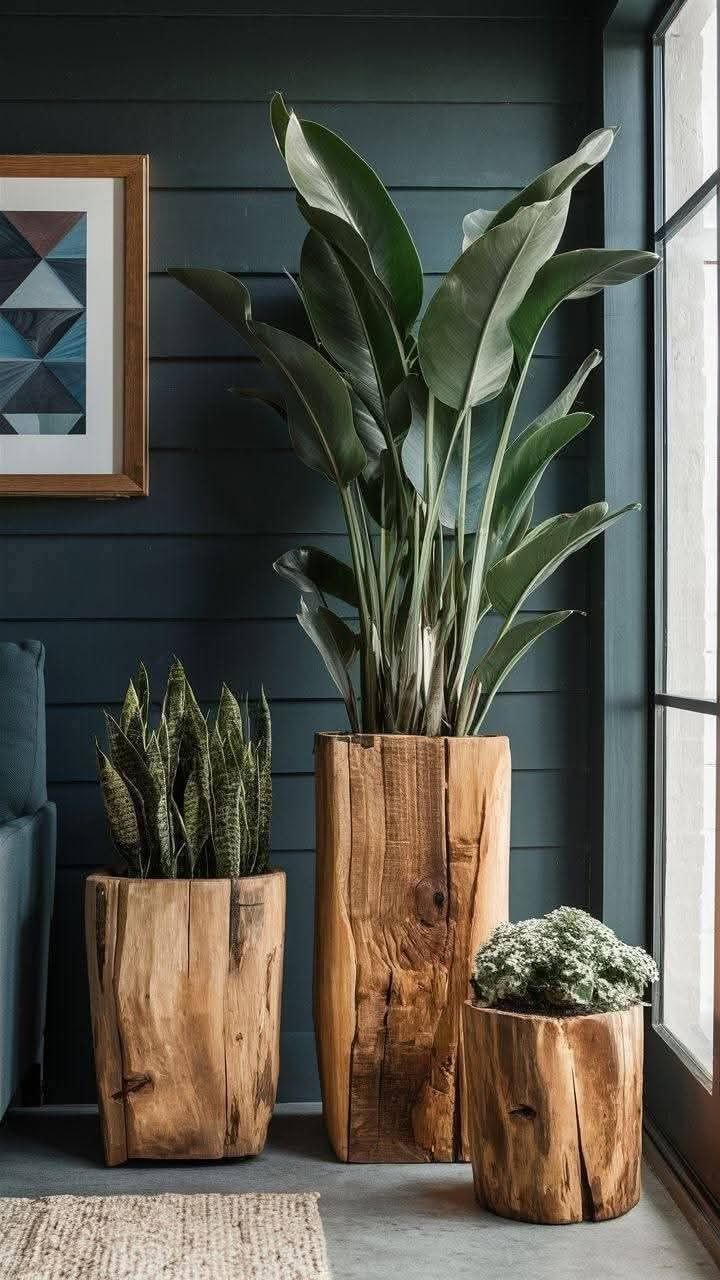
11. The Organic Wood Slice Platform
A slice of actual tree trunk is the most literally natural plant stand possible.
Sanded smooth on top and sealed with clear finish, it brings the outdoors inside in the most honest way — not as an aesthetic reference but as an actual piece of the natural world.
No two are the same. The grain, the color, the shape, the ring count — all unique. Which means your plant stand is inherently one of a kind. That’s a design quality that money genuinely cannot purchase.
12. The Endlessly Customizable Pegboard Display
A pegboard is the most honest representation of how plant collections actually work: always changing, always growing, always needing a different configuration.
Rather than committing to a fixed shelf layout that stops working when you acquire a new pot or lose a plant, the pegboard lets you continuously adapt without tools, wall damage, or decision fatigue.
It’s a living display system in every sense of the word.
13. The Artful Broken Chair Planter
Repurposing a broken chair as a plant stand is one of those ideas that sounds questionable until you see it executed well.
Remove the seat panel. Slip a pot into the opening. Let a trailing plant like a pothos or string of pearls flow down over the legs.
The chair reads differently than it did as furniture. It becomes something more interesting — a sculptural object with a narrative, a found object reimagined, the kind of thing that defines a room’s personality rather than just filling its space.
14. The Monochrome PVC Sculpture Garden
PVC pipe, cut into varying heights and painted uniformly, becomes something unexpected when arranged as a tight cluster.
The key is the monochrome treatment — all painted the same color, capped with identical wood discs — which shifts the focus from “what material is this made of” to “what beautiful sculptural grouping is this.”
The varied heights are the composition. Think of it the way a musician thinks of rhythm — the intervals between the high and low notes are what make it music rather than noise.
15. The Graphic Wire Frame Holder
A geometric wire frame is one of those objects that manages to be both minimal and visually complex at once.
The structure is open — you can see through it — which means it doesn’t visually block anything. But the geometric precision of the angles and edges creates a strong graphic presence that commands attention.
Against a white wall with a green plant nested inside, it has the clean graphic quality of a logo or an architectural model. It takes patience. It pays off.
16. The Sunlit Window Ledge Garden
Installing a shelf across the window frame interior is one of those changes that immediately transforms how a room feels.
Suddenly the window isn’t just a source of light — it’s a living green panel. The light shines through and around the plants, creating dappled, shifting shadows on the floor and walls throughout the day.
The aesthetic payoff far exceeds the fifteen-minute installation effort. This is the definition of high-impact, low-effort.
17. The Cheerful Rolling Garden Cart
A rolling utility cart filled with plants has an appealing cheerfulness about it — it looks like something that belongs in a greenhouse or a Parisian flower shop.
The practicality is an added bonus. Wheels mean the garden moves with the best light. No plant is ever stranded in inadequate sun again.
Style it with a mix of textures — ceramic pots, terracotta, and woven baskets arranged on the tiers — and it becomes a moment in the room rather than just storage on wheels.
18. The Shadow Box Wall Mount
A simple open wooden box mounted on the wall turns a plant into a piece of wall art.
The box depth creates shadow and dimension around the plant — it’s lit differently than a plant on a flat shelf because the surrounding frame controls the eye and focuses attention inward like a spotlight.
Three mounted in a clean horizontal row creates a gallery wall that’s alive and growing. It changes with the seasons. It needs watering and sunlight. It’s the only gallery wall format that can’t be faked with prints.
19. The Layered Textile and Wood Vignette
Pairing a woven basket with a low wooden stool creates one of those layered-texture moments that styled interiors do intentionally and consistently.
Wood grain plus woven fiber plus living plant — three entirely different textures occupying the same visual space — creates a richness and warmth that single-material displays rarely achieve.
It looks like the result of considered effort. The reality is it took about thirty seconds to assemble.
20. The Cascading Hanging Wire Tier Garden
Tiered hanging wire baskets converted to plant displays have a wonderful practical elegance about them.
Three levels of greenery cascading down from a ceiling hook, each tier a different plant, filling vertical space that would otherwise be empty air.
Position near a window for best light and you get the added effect of light filtering through multiple layers of foliage — creating the kind of dappled, greenhouse quality that makes a room feel genuinely lush.
21. The Studied Book Stack Pedestal
The book stack plant stand only works when it looks deliberate.
Choose books with spines that coordinate — all cream and white, or all earth tones, or a gradient from dark to light. Stack them with careful alignment. Add a saucer on top.
In a reading corner or study, this display makes an elegant statement about the connection between cultivation and curiosity — plants and books both requiring patience, both rewarding sustained attention.
It only reads as designed when the intention is obvious. Make the intention obvious.
The Proportion Principle Behind Every Beautiful Plant Display
Here’s the design secret that separates a beautiful plant display from a merely okay one.
It’s not the material. It’s not the finish. It’s not the color.
It’s proportion.
A large, spreading plant on a tiny, lightweight stand looks top-heavy and precarious. A small, delicate plant perched on a massive pedestal looks swallowed and lost.
Match the visual mass of the plant to the visual mass of the stand. The two should feel balanced — like they belong to each other. When that relationship is right, the display reads as intentional no matter what the stand is made of.
The One Reason Beautiful Rooms Stay Out of Reach
You’ve read through the whole list. You have favorites. You’re already picturing a couple of them in your space.
Here’s the honest risk: that picture stays a picture.
The inspiration gets bookmarked and filed away. Life continues. The plants stay on the floor. The room stays fine.
Inspiration without action is just decoration for your imagination.
Beautiful spaces aren’t created by people who have more time or more skill. They’re created by people who pick one thing and actually do it.
You have everything you need. The only missing ingredient is the follow-through.
Your Move
Go back to the top. Read through your shortlist.
Pick the one that felt most exciting and most doable at the same time.
Not the most impressive — the most achievable.
Get the materials. Set aside a Sunday afternoon. Build it.
Place your plant on it. Step back.
Notice how differently your room feels with that single change. Not because of what it cost. Not because of how long it took. Because you made something with purpose, and placed it with intention.
That’s the difference between a room that feels assembled and one that feels alive.
Your plants have been patient.
Go reward them.
Start this weekend.