How Japandi Interior Style Transforms a Stressful Home Into a Peaceful One
Disclosure : This post may contain affiliate links or paid partnerships. I may earn compensation if you click a link or make a purchase, at no additional cost to you. See my disclosure for more info.
Stop for a second.
Picture walking through your front door right now. After a full day. Tired, maybe a little frayed.
What’s the first thing your body does?
If the answer isn’t “relax,” something is off — and it’s probably not your taste in decor.
Your home might be relatively tidy. You’ve got nice cushions on the sofa. There’s a coffee table with things arranged on it. Decorative items in multiple rooms.
And yet… it doesn’t feel like rest. It feels like more.
You’ve probably tried to fix it. Spent time on Pinterest. Bought new throw pillows. Moved things from room to room in search of the right configuration.
The room still doesn’t click.
What’s really going on is this: Western decor is built around the idea of adding. It rewards accumulation. It fills silences.
Your nervous system wants the opposite of that.
Japanese interior philosophy — and its modern Japandi evolution — is one of the few design traditions built around giving your mind room to rest.
Not a bare, cold aesthetic. Not minimalism that feels punishing. Something more human: a home that holds only what it needs to.
You don’t need to start from scratch to get there. You just need to know where to start.
Here’s how.
A Clean Room Can Still Feel Crowded — Here’s Why
This is one of those things nobody tells you.
You can clean your home from top to bottom and still feel vaguely on edge inside it.
The reason: your brain is responding to visual complexity, not mess. Every decorative item, every pattern, every object on a surface is a piece of information your mind has to process — continuously, passively, whether you want it to or not.
A busy shelf with fourteen things on it? Fourteen low-grade demands on your attention, running quietly in the background.
A boldly patterned rug under contrasting curtains? Your visual cortex never quite settles.
Japanese design philosophy addressed this long before modern neuroscience gave it a name. The principle has always been this: what you choose to leave out matters as much as what you keep.
That reframe is everything.
The Three Concepts That Drive Japanese Interior Thinking
To actually apply Japandi design — rather than just collect its aesthetic pieces — you need to understand three ideas first.
Without these, your room will look like a mood board, not feel like a sanctuary.
1. Ma (間) — The value of emptiness
Western convention tells us blank walls need pictures and empty corners need furniture.
Ma says: emptiness has its own function. It isn’t absence — it’s presence. Space is where the eye rests and the mind quiets.
2. Wabi-sabi — Imperfection as the point
That handmade ceramic piece with a slightly uneven glaze? In wabi-sabi, that’s the most beautiful thing about it.
This concept moves you away from chasing the flawless, magazine-ready interior and toward choosing objects with real character — things that carry the marks of being made by human hands.
3. Kanso — Stripping away the excess
Kanso is about editing your environment down to what genuinely belongs there. Not starkness. Not deprivation. Just a clear-eyed assessment: does this earn its place?
If not, it’s taking up more than space.
These three form the philosophical spine. The practical steps all hang from here.
1. Remove Before You Consider Adding Anything
This is the uncomfortable truth at the center of all of this.
You cannot arrive at a calm space by introducing calming objects into a crowded one. The math doesn’t work.
The first move is subtraction.
Move through each room. Collect every single decorative object into one place — a table, a box, a corner of the floor. Every candle, frame, vase, and ornament.
Then return each item individually. Ask one question about each: does this actually make me feel better when I see it?
Not: was it a gift? Not: did it cost a lot? Does it make you feel better right now, in this room?
The ones that pass stay. The others leave. That number may be smaller than you expect. That’s exactly correct.
The shelf that held twenty items and still felt restless will feel different with four items placed with room between them.
2. Build a Color Story Around Natural Tones
Open any image of a traditional Japanese interior and look at the palette.
It’s composed and quiet. Warm whites. Stone grays. Earthy browns. Occasional touches of charcoal or muted olive.
You won’t find a terracotta feature wall next to teal cushions.
The reason is physiological as much as aesthetic. Saturated, high-contrast color schemes put your nervous system on alert. That’s useful in certain contexts. Your bedroom at 10pm is not one of them.
A cohesive, nature-drawn palette allows the eye to move through a space without stumbling. It feels consistent rather than competitive.
Start without touching paint.
Replace a loud throw with one in warm linen tones. Switch patterned or colorful cushion covers for ones in sand, clay, or warm gray.
The mood in the room will shift faster than you expect.
3. Prioritize Real Materials Over Imitations
There’s a simple reason Japanese interiors feel alive even when they’re sparse: the materials are genuine.
Solid timber. Rough-hewn stone. Natural fiber weaves. Hand-thrown ceramics. Undyed cotton and linen.
These materials carry warmth and depth that manufacturing can suggest but never fully reproduce. Grain, texture, weight, variation — qualities that make a material feel real under your hand and alive to your eye.
The mistake most people make is furnishing with convincing-looking synthetics and then wondering why the room feels flat.
Invest where it counts. A solid wood end table over a laminate equivalent. A handcrafted ceramic vessel over a mass-produced plastic one. Woven linen window panels instead of polyester curtains.
Replace gradually. Each real material you introduce deepens the room a little more.
4. Bring Your Furniture Closer to the Ground
Almost no Western decor guide mentions this. It’s one of the most impactful changes you can make.
Japanese interiors have always favored low-slung furniture. Tables that sit close to the floor. Beds that barely clear the ground. Seat cushions placed directly on tatami.
This isn’t arbitrary tradition. Lower furniture makes the ceiling appear higher. It opens the middle and upper portions of the room to air and light. And there’s something psychologically grounding about furniture that keeps you close to the floor.
You don’t have to sit cross-legged for dinner. But consider these practical adjustments:
Trade a tall bed frame for a low platform bed. Choose a lower-profile coffee table. Place floor cushions as flexible seating options.
The ceiling suddenly seems further away. The room breathes.
5. Rethink Your Approach to Lighting Entirely
Across so many homes, there’s one fixture doing all the work: a single overhead light, bright enough to perform surgery under.
It might be functional. It is absolutely killing the atmosphere.
Japanese interior lighting is built on an entirely different logic: multiple warm, low-intensity sources distributed through the space. Handmade paper lanterns. Washi paper floor lamps. Candlelight. Upward-facing wall washers.
The foundational idea: several gentle light sources will always create more comfort than one powerful one.
In practice, this means a soft-shaded floor lamp in the room’s quieter corner. A warm table lamp on the nightstand. Candles on the bookshelf.
The ceiling light becomes optional — something you switch on only when you need it.
The room becomes somewhere you actually want to be in the evening.
6. Use One Natural Element Instead of Many
Nature belongs in Japanese interior design. But the approach is completely different from what Western decor accounts usually show.
It’s not about maximizing green coverage or showcasing your plant collection across every available ledge.
It’s about one carefully chosen piece of the natural world, given enough space to register.
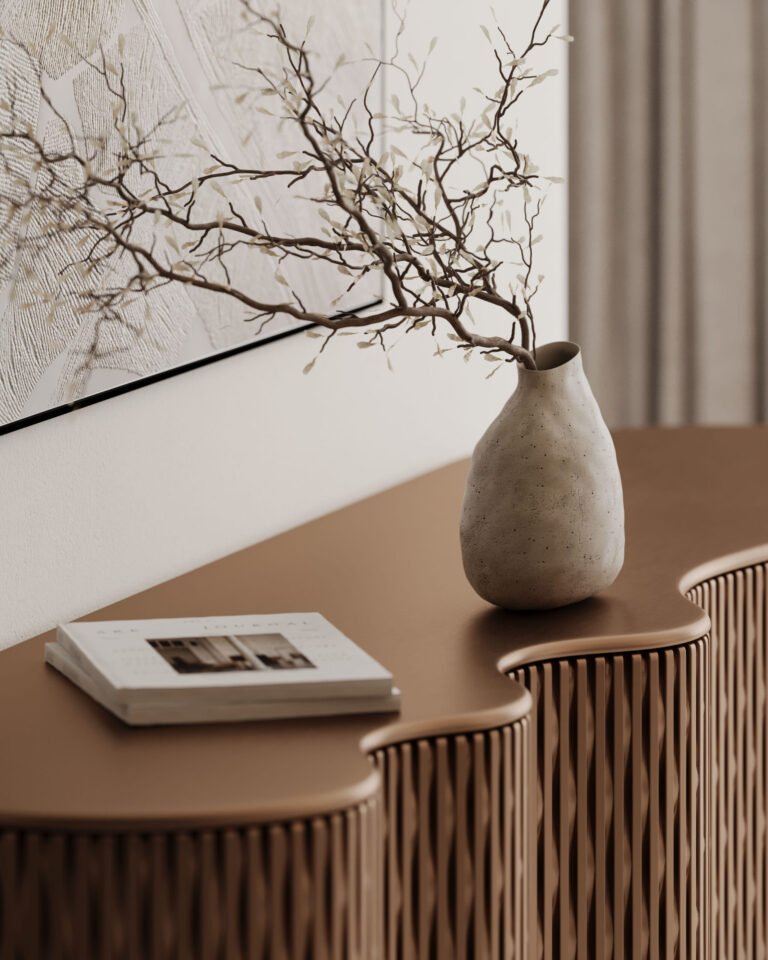
A single flowering branch in a simple ceramic vase. A bonsai tree given its own space on a shelf. A small collection of river stones in a shallow bowl.
Less is genuinely more here. A single element with breathing room creates a focal point. A dozen elements create noise.
That’s Ma at work again — emptiness as the thing that gives the object its power.
7. Build a Concealment Strategy for Everyday Clutter
Real talk: you’re not going to live a clutter-free life. Nobody does.
There are remotes, charging cables, children’s belongings, mail, and a hundred other things that are simply part of existing in a home.
Japanese design doesn’t pretend otherwise. Instead it builds systems to keep that clutter invisible. Cabinets without visible hardware. Baskets inside shelving units. Closets that absorb the chaos and present a clean face to the room.
You don’t need a renovation to get there. You need two or three well-chosen natural fiber baskets — seagrass, wicker, or woven cotton — placed where clutter naturally accumulates.
Beside the sofa. Near the front door. On a wall-mounted shelf.
The objects inside become invisible. The surface stays calm. The room stays calm.
Underestimated strategy. Surprisingly powerful result.
8. Put Space Between Things on Purpose
You can do this right now. It costs nothing.
Go to the surface with the most objects on it in your home. Your bookcase. Your mantle. Your bathroom counter.
Take half of what’s there away. Then spread out what remains.
Where there were three objects touching, let one stand alone with several inches of clear space around it.
Where books were packed shoulder to shoulder, group them in small clusters with deliberate gaps.
Watch what happens to how the surface reads. Items that were invisible in the crowd suddenly have presence. The eye can move to each one with intention rather than skipping across a mass.
That’s what makes a space feel curated rather than accumulated.
9. Divide Zones with Soft, Flexible Boundaries
In traditional Japanese architecture, shoji screens are the classic space-dividing tool: lightweight wooden frames holding translucent washi panels that slide to open or close areas of the home.
You probably don’t have shoji screens. You don’t need them.
What you need is the principle: boundaries between spaces that can flex.
A linen drape on a ceiling-mounted track can separate a sleeping area from a dressing area. A sliding timber panel can screen a cluttered laundry corner from the living room.
Each zone gains a sense of purpose and privacy without hard walls going up. When zones have purpose, the whole home feels more organized — and calmer.
10. Turn Your Entryway Into the First Calm Signal
Japanese domestic tradition places enormous significance on the genkan — the entryway. It functions as a transitional space: the boundary between the world outside and the world inside.
Outdoor shoes come off here. The mental weight of the day begins to lift here.
In Western homes, the entryway is usually where order first breaks down. Shoes piling up. Bags dumped. Keys buried. Coats folded over a chair.
Redesign this space with intention.
A small tray for keys and cards. A contained shoe storage unit. A single wall hook for your coat and bag.
One object that says: welcome. A green plant. A calm candle. One framed piece of art.
When the entryway is ordered, it sets the register for everything beyond it. You don’t carry the outside world in — you leave it at the threshold.
The Error That Cancels All of This Out
There’s a predictable mistake that happens after articles like this one.
People read it, feel inspired, and immediately start shopping for “Japanese-style” objects. A bamboo tray. A raku-inspired bowl. A noren curtain. A stone garden kit.
Please resist this impulse.
Japandi design is not an aesthetic you buy. It’s a principle you practice.
The practice begins with what leaves. It centers on choosing quality over accumulation. It rests on the belief that open space is not failure to decorate — it’s the decoration itself.
Add ten new things and you haven’t applied the lesson. You’ve just added ten more things.
Remove ten things instead. That’s the beginning of the transformation.
Your Home Is Already Closer to Calm Than You Think
You don’t need to relocate to Japan. You don’t need an architect or a budget that makes you wince.
What you need is a willingness to subtract. To resist the trained reflex to fill. To trust that a room with fewer things, arranged with intention, can feel more complete than a room full to its edges.
Begin somewhere small. A single shelf. The top of your nightstand. The entryway floor.
Pare it back. Give it space. Then sit with it for a while.
Feel whether the room asks something of you or offers you something.
When it offers — a kind of ease, a loosening of something you’d forgotten was tight — that’s the whole point of this philosophy in one quiet moment.
And from there, you’ll know exactly what to do next.
🔍 Focus Keyphrase: Japandi interior tips
📌 SEO Title (< 60 chars): Japandi Interior Tips to Calm the Chaos at Home
🔗 Slug (< 60 chars): japandi-interior-tips-calm-chaos-home
📝 Meta Description (< 155 chars): Discover modern Japandi interior tips to bring calm and intention to any room — no renovation needed. Start with less and transform your home today.