25 Ways to Design a Mediterranean Bedroom That Feels Like a Real Escape
Disclosure : This post may contain affiliate links or paid partnerships. I may earn compensation if you click a link or make a purchase, at no additional cost to you. See my disclosure for more info.
You know the feeling I’m talking about.
You walk into a room — maybe in a design magazine, maybe on someone’s Instagram — and something shifts. The air seems different. Slower. Warmer. You don’t want to leave.
That’s what a great Mediterranean bedroom does.
And it’s not magic. It’s not expensive. It’s not something that only happens in coastal villas abroad.
It’s the result of specific, repeatable decisions. Decisions about what to put in a room, what to take out, and which details to get precisely right.
I’m going to give you all of them. 25 specific ideas for creating a Mediterranean bedroom that genuinely feels like a retreat — not a theme park version of one.
The Architecture of the Room: Foundation Work First
The instinct when decorating is to reach for the accessories first. Cushions. Candles. Art.
Resist it. Fix the bones first. Everything else is amplified or undermined by what you do here.
1. Give the walls warmth with limewash or matte paint
Mediterranean walls don’t gleam. They glow.
The difference is the finish and the undertone. Ivory, cream, or warm off-white in a flat or matte finish absorbs light rather than bouncing it. It feels like a wall that has been in the sun for years.
Limewash paint goes further still — it creates an uneven, layered texture that catches light differently at different times of day. It is surprisingly easy to apply, and the result is striking.
2. Introduce terracotta tile or a natural-look floor treatment
Terracotta is the ground note of Mediterranean interiors. It is warm, earthy, and immediately recognizable.
If your existing floor cannot be changed, peel-and-stick terracotta-look tiles offer a convincing and completely reversible alternative. Over either surface, a natural jute or sisal rug adds softness and layers the natural textures.
3. Install an arched headboard or create an arched niche
The arch is to Mediterranean architecture what the column is to classical — it defines the style.
An arched upholstered headboard in natural fabric brings that defining shape into the bedroom without any structural work. For a more permanent solution, a built or faux plaster arch above the bed becomes the room’s defining architectural moment.
Color: The Logic Behind the Palette
The Mediterranean color palette has a logic to it that most people miss.
They see “Mediterranean” and reach for blue. Blue walls. Blue bedding. Blue everything. And they end up with a room that feels themed rather than real.
The actual palette is more nuanced — and more interesting.
4. Start with warm neutrals as the dominant tone
The dominant color of a Mediterranean bedroom is not a color at all, in the conventional sense. It is a range of warm neutrals — sandy beige, pale clay, warm taupe, aged linen.
These tones make up the majority of the room’s surface area. They are the canvas on which everything else is painted.
5. Use blue selectively and intentionally
A pair of indigo linen pillowcases. A ceramic blue vase on the bedside table. A tile or small ceramic piece in cobalt or navy.
Two or three blue elements in a sea of warm neutrals hit with extraordinary impact. That is exactly how the sea hits when you round a corner on a coastal hillside — a shock of color against the stone and the ochre.
6. Add terracotta and rust for warmth
A terracotta plant pot. A rust-colored throw blanket across the foot of the bed. A terracotta-tinted cushion cover.
This is the color of the rooftops. The sun-baked soil. The clay fired in a kiln somewhere near the coast. It grounds the room in the landscape rather than the sea.
7. Don’t overlook the role of green
Olive. Sage. Dried herbs. A terracotta planter full of rosemary.
The Mediterranean region is as famous for its green landscapes as for its blue water. sage green linen curtains at the windows, or a few well-placed plants, connect the room to that larger world.
Textiles: Natural, Imperfect, Layered
The textiles in a Mediterranean bedroom communicate everything.
They tell you whether you’re in a room that prioritizes comfort or one that prioritizes appearances. They tell you whether someone actually lives here, or whether this is a set.
Get them right, and the room feels right — immediately.
8. Make linen your default bedding fabric
Linen is not a luxury fabric. It is a working fabric — one that has been used in Mediterranean homes for centuries because it breathes, because it softens, because it gets more beautiful the more it is used.
Undyed or softly toned linen communicates more authenticity than any other single choice in the room.
9. Layer a casual throw over the bed
Not folded and placed. Not arranged.
Tossed. Draped. Lived-in.
A hand-loomed Turkish cotton throw adds texture and color in a way that looks effortless because, with the right piece, it genuinely is.
10. Hang curtains that filter light rather than block it
Heavy lined drapes are the single most common way people accidentally kill the Mediterranean feel they’ve been building.
Light must move through the room. Sheer white linen panels hung floor to ceiling and wide allow this while still providing some sense of privacy.
11. Use a flat-weave, kilim-style, or jute rug on the floor
Plush, synthetic, or heavily patterned rugs fight against the earthiness of Mediterranean interiors.
A vintage-style kilim rug in dusty reds, faded blues, and warm cream introduces pattern and color without overpowering the room. The texture itself — flat, natural, slightly rough — is part of the story.
Furniture: Honest Materials, Gathered Over Time
Think about the furniture in a farmhouse outside Naples. Or a whitewashed home on a Greek island.
It doesn’t match. It’s not new. It looks like it was found, acquired, inherited. And somehow that makes it feel more right than anything purchased as a coordinated set.
12. Ground the room with a solid wood bed frame
Oak. Pine. Walnut. Reclaimed timber.
The quality that defines Mediterranean furniture is honesty. Visible grain. A finish that lets the wood breathe. No attempt to disguise what the material is.
A low-profile platform bed frame with simple, clean proportions achieves this without visual clutter.
13. Put rattan or woven cane beside the bed
Swapping a standard painted or lacquered nightstand for a rattan alternative is one of the most effective single moves in this guide.
Rattan is warm, coastal, and natural. It works alongside almost any other material. A rounded rattan side table or a woven stool used as a nightstand transforms the entire character of the bedside area.
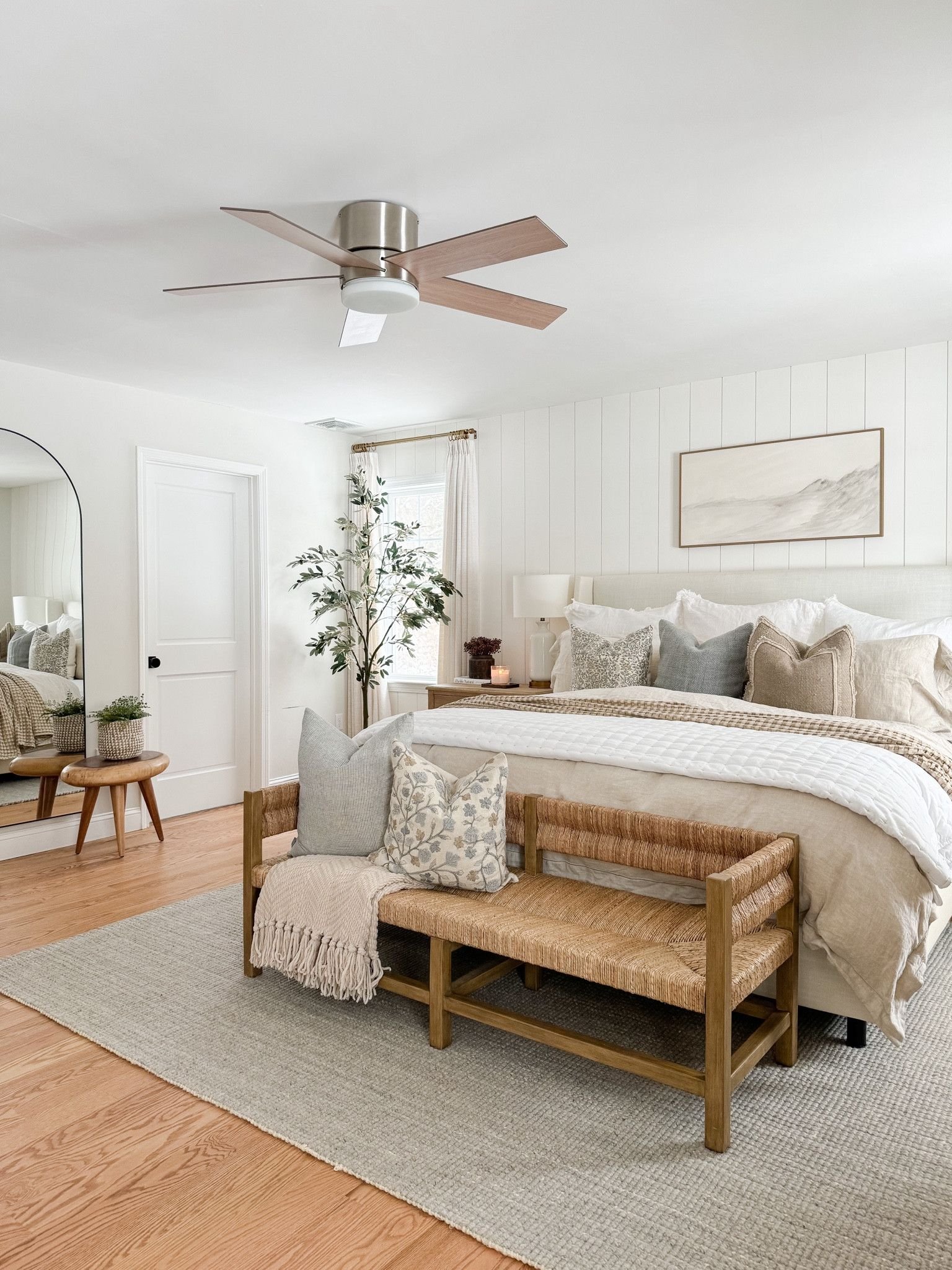
14. Add a wooden bench or stool at the foot of the bed
This is a piece that earns its place on both practical and aesthetic grounds.
A weathered bench at the end of the bed adds storytelling to the room — it looks as though it has a history. It also gives you somewhere to put things without turning the floor into storage.
15. Mix rather than match
This is not a compromise or a budget constraint. This is a design principle.
Mediterranean rooms are assembled over time. Two nightstands that complement each other without being identical. A dresser from a different era than the bed frame. The variety is part of what makes them feel real.
Decorative Details: Curate, Don’t Accumulate
This is where restraint becomes the most important skill.
The Mediterranean aesthetic is not a maximalist one. It doesn’t reward more. It rewards better.
16. Choose one organic mirror as a wall focal point
A round mirror — rattan or driftwood-framed, round or oval — does two things simultaneously: it adds warmth and organic texture to the wall, and it bounces light across the room in a way that makes the space feel larger and more alive.
17. Display handmade ceramics instead of mass-produced decor
A hand-thrown vase on the nightstand. A pottery bowl for small items. A candle holder with an uneven glaze.
The imperfection in these objects is a feature, not a flaw. Handmade ceramics carry the human touch that makes a room feel inhabited rather than styled.
18. Create a minimal, considered wall arrangement
Two pieces. Maybe three. Not more.
A botanical print in a simple wood frame. A small landscape photograph. An abstract in warm tones on a background of open wall. Let the wall breathe around them.
19. Introduce living and dried botanicals
Lavender. Rosemary. Olive branches. Dried citrus.
These elements do three things at once: they look right, they smell right, and they remind you that the room is part of a larger living world. That connection is fundamental to the Mediterranean way of inhabiting space.
20. Bring in iron and brass as supporting accents
A wrought iron curtain rod. Brass drawer pulls on a drawer. An antique brass table lamp casting warm light from the nightstand.
These metals carry age, craft, and warmth. Used in small doses, they add old-world character without tipping into pastiche.
Lighting: The Architecture of Atmosphere
Lighting in a Mediterranean bedroom is not about visibility. It is about the quality of being in the room.
That distinction changes everything.
21. Replace the overhead light with layered soft sources
The ceiling fixture is not your friend in this room. Stop using it.
Two table lamps with warm bulbs and a wall sconce on the wall create a completely different quality of light. Look for linen shades, ceramic bases, and rattan or wicker details. The materials of the lamp matter as much as the light it casts.
22. Build candles into your evening routine
A terracotta dish holding a thick pillar candle. A beeswax taper in a brass holder.
No light source creates atmosphere like fire. Not a warm bulb. Not a dimmer. Not string lights. The flicker, the warmth, the slight unpredictability of candlelight is irreplaceable.
Make it a habit. Light a candle when you sit on the bed to read. It will change the room completely.
23. Give natural light full access during the day
Throw the curtains open. If the view requires some filtering, use sheers — not because they are prettier, but because they allow light to continue doing its work in the room.
Mediterranean interiors are defined by their relationship with sunlight. A room sealed against it is a room working against itself.
The Last Details: Scent, Simplicity, and Intention
Almost there. These final two ideas are small in scale and large in effect.
24. Scent the room with intention
Lavender. Bergamot. Rosemary. Sea salt.
A diffuser running a clean, herb-based blend. A linen spray misted over the bed before you get in. A small dish of dried petals or citrus peel on the dresser.
The Mediterranean smells specific. Recreating that scent profile is one of the quickest and most powerful ways to transport a room — and yourself — somewhere else entirely.
25. Clear the nightstand to its most useful elements
Lamp. Book. Water glass. One small object of beauty.
Nothing else.
Simplicity in a Mediterranean bedroom is not about minimalism as a style. It is about allowing the room to breathe. Every object on that nightstand takes up not just physical space but visual space. Clear the unnecessary, and what remains becomes more meaningful.
The Room You Already Have Can Become the Room You Want
Here is the truth I want you to sit with.
The bedroom you want — the warm, unhurried, genuinely restful Mediterranean retreat — is not far from the bedroom you have. The distance is measured in decisions, not dollars.
Choose three things from this list. Make them real. Then choose three more.
The room will not transform overnight. But it will transform. And at some point, you will walk in at the end of a long day and notice that something has shifted — that the room has become the room you always meant it to be.
That moment is closer than you think.
🔍 Focus Keyphrase: Mediterranean bedroom ideas
📌 SEO Title (< 60 chars): 25 Mediterranean Bedroom Ideas for a Coastal Escape
🔗 Slug (< 60 chars): mediterranean-bedroom-ideas
📝 Meta Description (< 155 chars): Discover 25 stunning Mediterranean bedroom ideas to create a warm, coastal retreat. Start transforming your space today with these actionable tips.