Kitchen Lighting Secrets: 29 Ideas That Interior Designers Actually Use
Disclosure : This post may contain affiliate links or paid partnerships. I may earn compensation if you click a link or make a purchase, at no additional cost to you. See my disclosure for more info.
There is a reason professionally designed kitchens always look different from most.
It is not always the cabinets or countertops or hardware. Very often, the difference comes down to the lighting strategy. Designers approach kitchen lighting as a planned system, not a series of individual purchases. They think in layers, consider function first, and choose fixtures last.
These 29 ideas lay out the complete system — from ambient foundation to accent finishing touches — the way designers actually build it.
Why Professionally Designed Kitchens Always Look Better Lit
Lighting does not just illuminate a kitchen. It shapes how every element in the room is perceived — cabinet color, countertop texture, whether the whole space reads as warm or cold.
Designers build three layers in every kitchen they work on. Ambient provides room coverage. Task illuminates functional surfaces. Accent adds depth and draws attention to design features. Each is necessary. None is optional. This guide shows you how to build all three.
Ambient Light: The Layer Designers Plan First, Every Time
In every well-designed kitchen, the ambient layer is warm, even, and dimmable. It is the base that every other light source builds on top of.
1. Recessed ceiling lights on a dimmer circuit
Every kitchen worth designing has dimmable ambient light. A dimmer switch is not a luxury — it is the tool that lets the same room function as a bright prep space in the afternoon and a warm dinner setting in the evening. Designers specify this on every project.
2. Flush mount with a frosted diffuser
When recessed fixtures are not possible, a flush mount with a frosted diffuser scatters light broadly without the glare and hot spots of clear glass. The frosted surface eliminates visual discomfort that most homeowners attribute to the room rather than the fixture.
3. Semi-flush mount with a linen or fabric shade
A semi-flush mount with a linen or fabric shade re-emits light softly in a way glass cannot replicate. Designers use these in kitchens that need to feel residential rather than functional. The shade changes the entire character of the ambient layer.
4. Slim LED panels for constrained ceiling heights
Slim LED panels that sit flush with the ceiling preserve vertical space in low-ceiling kitchens while delivering strong, even light. The correct solution wherever ceiling height is a design constraint.
5. Cove lighting at the ceiling line
One of the most frequently specified designer details in kitchen lighting. LED strip lights set into a ceiling soffit emit upward, bouncing a diffused warm wash off the ceiling that adds height, removes shadows, and produces light quality that direct overhead sources cannot match.
Task Light: Where Function and Aesthetic Work Together
Designers treat task lighting as a design layer, not just a functional one. The best installations solve a practical problem while contributing meaningfully to the room’s visual character.
6. Under-cabinet LED strips
The single most universally recommended kitchen lighting upgrade. Under-cabinet strips eliminate the shadow problem that overhead fixtures create on every countertop, dramatically improve prep visibility, and accent the backsplash in a way no ceiling fixture achieves. Adhesive kits require no electrician.
7. Under-cabinet puck lights
Where strips provide continuous illumination, puck lights provide focused spots. Designers use them when a kitchen has distinct prep stations or when a more directional, spotlight-like effect is preferred over a continuous band.
8. Pendant lights above the island
Island pendants are among the most impactful single decisions in kitchen lighting. They light the surface below and anchor the room above. At 30 to 36 inches above the counter, they deliver both function and visual structure.
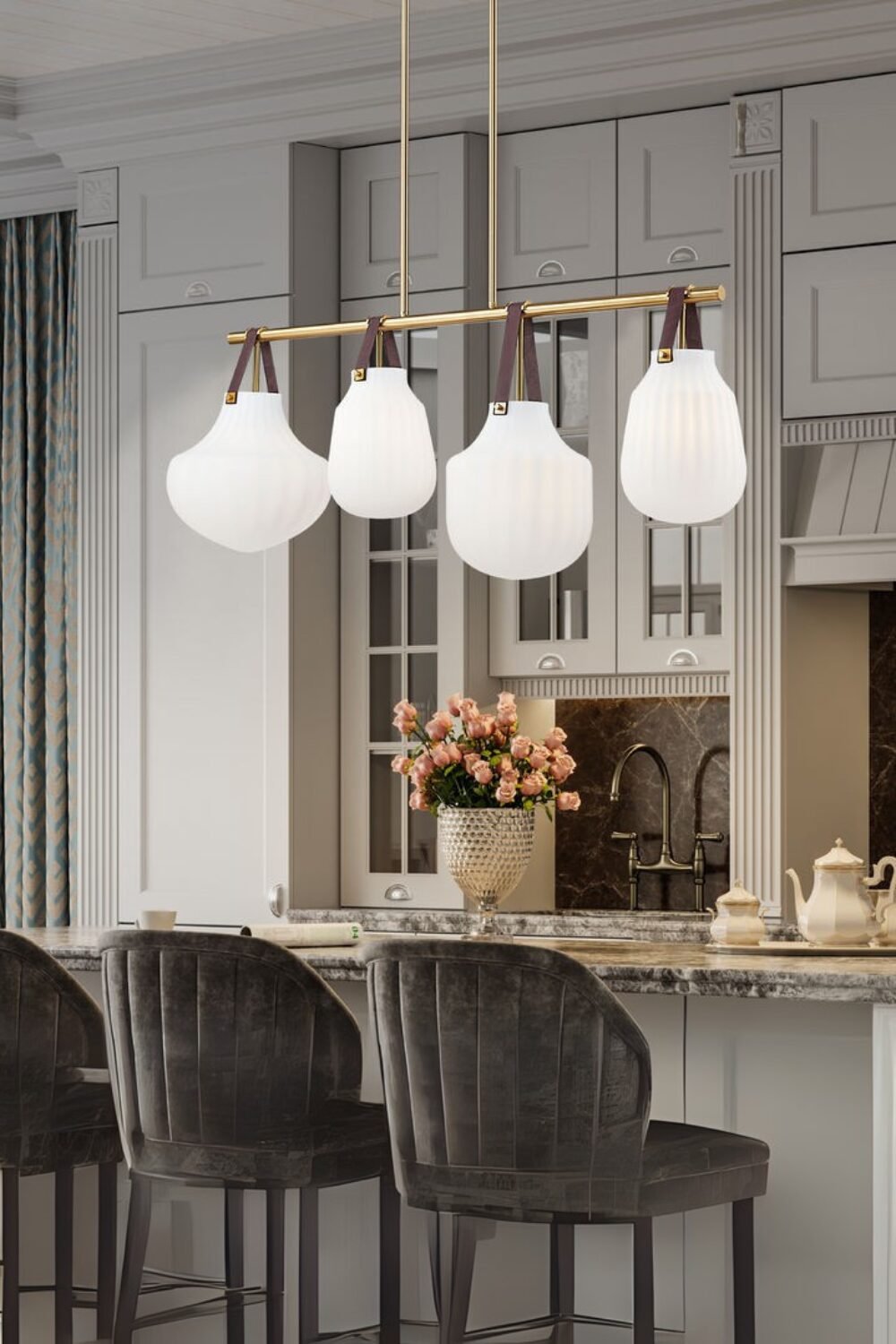
9. Linear pendant over the island
A single linear suspension fixture is the more architectural choice for contemporary kitchens — uniform coverage, a clean horizontal line, and less visual complexity than multiple individual pendants overhead.
10. Directional track lighting
Modern track systems give designers something no fixed fixture offers: the ability to redirect light post-installation. For kitchens with irregular layouts or multiple distinct work zones, they are often the technically correct choice.
11. Swing-arm sconce near the range
Designers use this where it will perform and surprise. A swing-arm sconce beside the cooktop provides the closest, most adjustable task light possible at the cooking surface and introduces a design detail that standard task fixtures never replicate.
12. High-quality bulbs in the range hood
The range hood’s built-in light is consistently overlooked. Stock bulbs are weak and unflattering. Warm, high-output LED replacements make the stovetop properly lit in five minutes.
Accent Lighting: The Designer’s Most Powerful Finishing Tool
If ambient and task handle what needs to function, accent lighting handles what needs to feel exceptional. This is the layer where a kitchen’s personality is revealed.
13. Interior lighting in glass-front cabinets
Glass doors without interior lighting are an incomplete design idea. LED puck lights or strips inside the cabinet complete what the glass promises — a display that reads as curated and intentional at all hours.
14. LED strips on top of upper cabinets
LED strips on top of upper cabinets, aimed at the ceiling, create an indirect warm wash that adds height and a layer of ambient richness that no overhead fixture delivers from above. A high-reward, low-cost accent detail.
15. Toe-kick lighting along the base cabinets
LED strips in the toe-kick channel create a floating effect that looks expensive at any hour. Designers include this as a finishing layer that makes the kitchen feel complete — and as a practical low-level nighttime ambient glow.
16. Underlighting for open shelves
Open shelves are a design feature. LED strips under each shelf treat every displayed object as worthy of a gallery light. Without them, the display disappears after dark.
17. Illuminated kickboard panels
Translucent glowing kickboard panels are a high-design contemporary detail that produces a continuous light line at floor level. In kitchens with a clear modern design language, this is a showpiece detail that no other accent achieves.
18. Auto-illuminated deep drawers
Motion-activated LED strips inside deep drawers make contents visible the moment the drawer opens. Battery-powered, wireless, and a small luxury that makes the kitchen feel better-built than its actual cost suggests.
Statement Fixtures: The Design Decisions That Define the Kitchen
A single exceptional fixture makes a stronger statement than a room full of competent, unremarkable ones. Designers know when to let one piece carry the room.
19. One commanding oversized pendant
A large pendant — sculptural woven rattan, hand-blown glass, or architectural metal — above the island becomes the room’s visual anchor and gives the kitchen a clear point of view.
20. A chandelier in the kitchen dining zone
A chandelier scaled to the dining area transforms an eating space into a defined, hospitable destination. The kitchen becomes a room people are drawn toward, not merely directed to.
21. Lantern-style pendant lights
Lantern pendants distribute light broadly through open cage frames while bringing historical craft and architectural quality to the ceiling plane. Cross-style compatible and exceptionally durable as a design choice.
22. A curated pendant cluster
A cluster of small pendants at staggered heights creates a composed, organic canopy that reads as designed rather than installed. Designers use it to add overhead movement without a single large fixture.
Smart Lighting: Technology That Earns Its Place
Good lighting strategy uses technology where it adds genuine value. These four approaches consistently earn their specification.
23. Tunable color temperature smart bulbs
Smart bulbs that shift color temperature on demand or on schedule let the same fixtures serve a morning prep environment and an evening dinner atmosphere. No rewiring. Standard socket. Immediate benefit.
24. Motion-activated interior cabinet lights
Wireless, battery-powered lights that take five minutes to install and activate automatically when a door opens. Low effort, daily benefit, immediately appreciated.
25. LED-integrated cabinet hardware
In kitchens with a contemporary design direction, LED-integrated handles produce a continuous, subtle glow along the cabinet fronts. A specialist detail that communicates serious design intention.
26. Solar tubes for natural daylighting
Designers specify solar tubes routinely in kitchens that lack adequate window access. A reflective conduit from roof to ceiling diffuser delivers genuine natural light without structural window work. Nothing artificial fully replicates it.
The Technical Foundations: Color Temperature and Placement
Fixture selection made without understanding these principles produces results that consistently disappoint. These are not optional refinements.
27. Specify 2700K to 3000K throughout the kitchen
Bulbs above 4000K are designed for clinical and commercial environments. In a home kitchen they produce cold light that harshens surfaces and makes the space deeply uncomfortable to occupy.
2700K to 3000K is the residential standard. Everything looks better in it — stone, wood, ceramics, food, and people equally.
28. Uniform color temperature, variable brightness
Every fixture in the kitchen must use the same color temperature. Mixing warm and cool sources creates a visual tension that people sense as wrong without identifying. Use dimmers for intensity control. Color temperature is a constant. Brightness is the variable.
29. Mount task lights between the user and the surface
A task light behind the user illuminates their back, not their cutting board. Under-cabinet strips at the front edge of the cabinet base place light correctly — between the worker and the surface. Shadows fall behind. This is the technically correct position. No exceptions.
The Strategic Error That Undermines Even Expensive Plans
Designers see this constantly: a homeowner buys a fixture they love, hangs it, and discovers it solves nothing. The kitchen is still flat. The counters are still dark. The beautiful fixture they bought is doing very little useful work.
Leading with the fixture rather than the plan.
The correct process: audit the three layers, identify what is incomplete, choose fixtures that address the specific gaps. Every fixture should have a function and a deliberate position. That discipline is what separates a lighting plan from a lighting purchase.
The Kitchen You Deserve Starts With the Lighting It Has Been Missing
Every kitchen can look and feel significantly better than it currently does. The renovations can wait. The first upgrade that changes how the room feels to be in is the lighting.
Begin with the layer most obviously missing. Follow the plan. The transformation is faster and less expensive than any improvement of equivalent impact. And once you experience a properly layered kitchen, the previous version becomes very difficult to go back to.